

🗣️ The Most Expensive Fight in Your Company
It’s the 10:00 AM RevOps meeting. The VP of Marketing proudly points to a dashboard: "We delivered 200 MQLs last month, 10% over target."
The VP of Sales leans back and crosses his arms. "That's great. But my team says those 'MQLs' are garbage. We closed zero of them. We're wasting our time."
This single, recurring argument is the most expensive problem in your B2B company. It's the sound of your "revenue machine" grinding to a halt.
As a B2B leader, you know the pain. Marketing invests thousands in campaigns, hits its "MQL" target, and celebrates. Sales receives an avalanche of "leads" that are actually just contacts who downloaded a 3-year-old whitepaper. The sales team, forced to follow up, quickly learns that MQLs are worthless. They begin to ignore all new leads, including the good ones.
The result? Trust is destroyed. Marketing thinks Sales is lazy. Sales thinks Marketing is clueless. And your "self-driven" HubSpot portal has become the system of record for this corporate cold war.
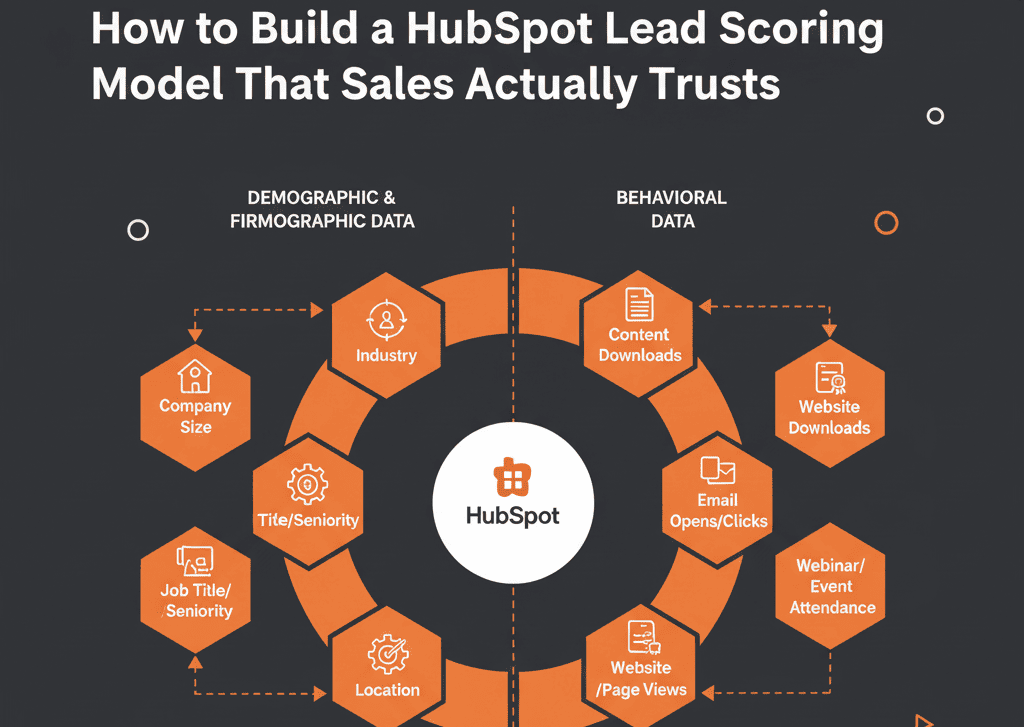
The problem isn't the idea of lead scoring. The problem is your model. You've built a "glorified activity tracker," not a "buyer-intent system."
You cannot build a lead scoring model that Sales trusts... until you stop scoring "activity" and start scoring "intent." Here is how to diagnose your broken model and build one that works.
🔬 Diagnosis: Why Your "Traditional" Lead Scoring Fails
Your HubSpot lead scoring model is likely broken if it's built on a traditional, "additive" model. This is where you assign simple points:
- Downloaded eBook = +5 points
- Job Title = 'Manager' = +10 points
- Company Size > 100 = +10 points
- MQL Threshold = 50 points
This model is fundamentally flawed. It produces a "score" of 50, but it tells the salesperson nothing about the lead's actual intent.
Scenario A: A student in India with a fake company name downloads 10 eBooks. Score: 50. (MQL)
Scenario B: The VP of Engineering at your #1 target account (a $500k deal) visits your pricing page three times in one hour. Score: 15. (Not an MQL)
Your system just told your sales team to ignore the $500k whale and instead harass a student in India. This is why your sales team hates your MQLs. You're scoring "noise," not "signal."
⚙️ The Fix: The "Credit System" Model for RevOps
To build a model that Sales trusts, you must separate "Fit" (demographics) from "Intent" (behavior). Stop mashing them together into one ambiguous "score."
At ElanceMind, we build a "Credit System" for our clients. It's a "self-driven" model that operates on two simple, separate axes. This is the only way to create a "Configuration Plan" for leads.
Step 1: Define Your "Fit" (The ICP)
First, stop talking about "points." Start talking about "grades." Your sales team knows who your ideal customer is. Define this objectively using HubSpot properties. This is your "ICP Grade."
- ICP Grade A (High Fit): Company Size is 20–200 employees + Industry is Manufacturing/SaaS/Tech.
- ICP Grade B (Medium Fit): Company Size is 20–200 (any industry) OR Industry is a match (any size).
- ICP Grade C (Low Fit): Everyone else.
- ICP Grade D (Junk): Email contains 'gmail.com' OR Job Title contains 'Student'.
How to build this in HubSpot: Use a Contact workflow. Create a custom dropdown property called ICP Grade. Use if/then branches to assign A, B, C, or D based on static, demographic data.
Step 2: Define Your "Intent" (The "Money" Actions)
Second, stop giving "points" for "top-of-funnel" actions like downloading an eBook. Your reps don't want "readers"; they want "buyers."
You must create a separate "Intent Score" that only tracks "bottom-of-funnel" (BOFU) actions. These are the "money" clicks.
- High Intent (+25): Filled out "Contact Us" or "Request a Demo" form, or visited the Pricing Page 3+ times in 7 days.
- Medium Intent (+10): Viewed a high-value Case Study page or attended a Product Webinar.
- Low Intent (+1): Opened an email or downloaded a "Top 10 Tips" eBook.
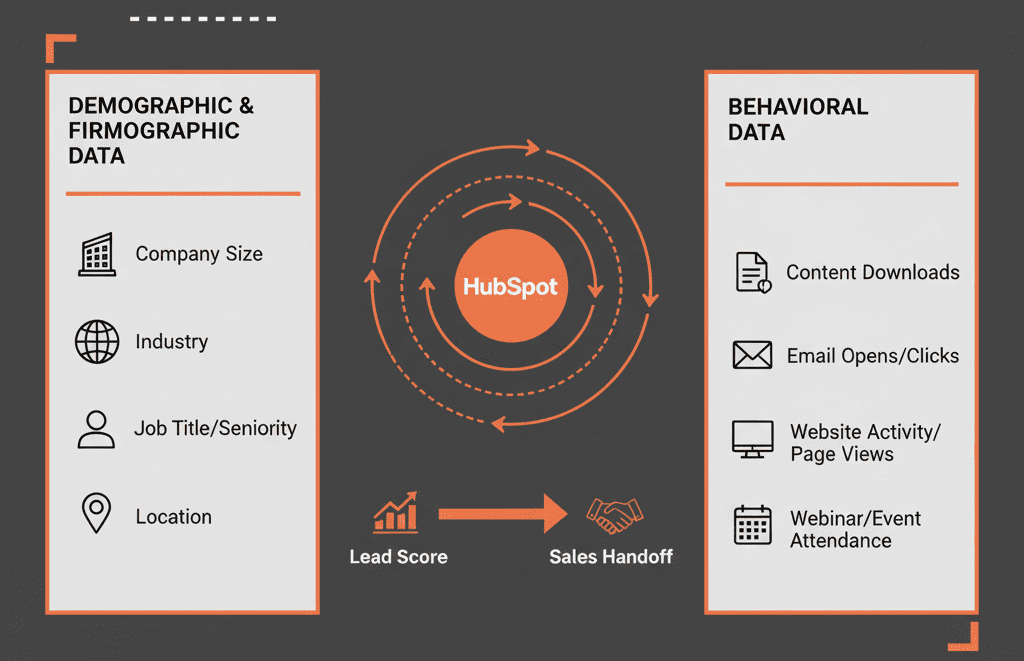
Step 3: Create the "Sales-Ready" Matrix
Now you have two separate, clean data points:
ICP Grade (A, B, C, D): How good a fit are they?
Intent Score (0–100): How interested are they?
You no longer have one "MQL" definition. You have a "Sales-Ready Matrix" — and this is what Sales will finally trust.
- Priority 1 (The MQL): ICP Grade = A or B AND Intent Score > 25 → Send to Sales immediately.
- Priority 2 (Nurture – High Fit): ICP Grade = A or B AND Intent Score < 25 → Keep in Marketing nurture.
- Priority 3 (Sales Review – High Intent): ICP Grade = C AND Intent Score > 25 → Send for manual review.
- Priority 4 (Ignore): ICP Grade = D OR (C + Low Intent) → No action.