

🍰 The "Participation Trophy" vs. The "Closer"
You spent $50,000 on marketing this month.
- $10k on LinkedIn Ads.
- $10k on Google Ads.
- $10k on Content.
- $20k on Events.
You closed $100,000 in Annual Recurring Revenue (ARR).
Now, the CFO asks: "Which channel drove that revenue?"
If you use Linear Attribution, you say: "Everything worked equally well."
If you use Multi-Touch Attribution, you say: "LinkedIn started the conversation, but the Webinar closed the deal."
For a SaaS company, choosing the wrong model isn't just a reporting error; it is a Budgeting Disaster.
If you fund the wrong channel, your CAC (Customer Acquisition Cost) explodes.
HubSpot attribution reporting supports multiple models (including linear, W-shaped, and full-path) to assign credit across a customer journey.
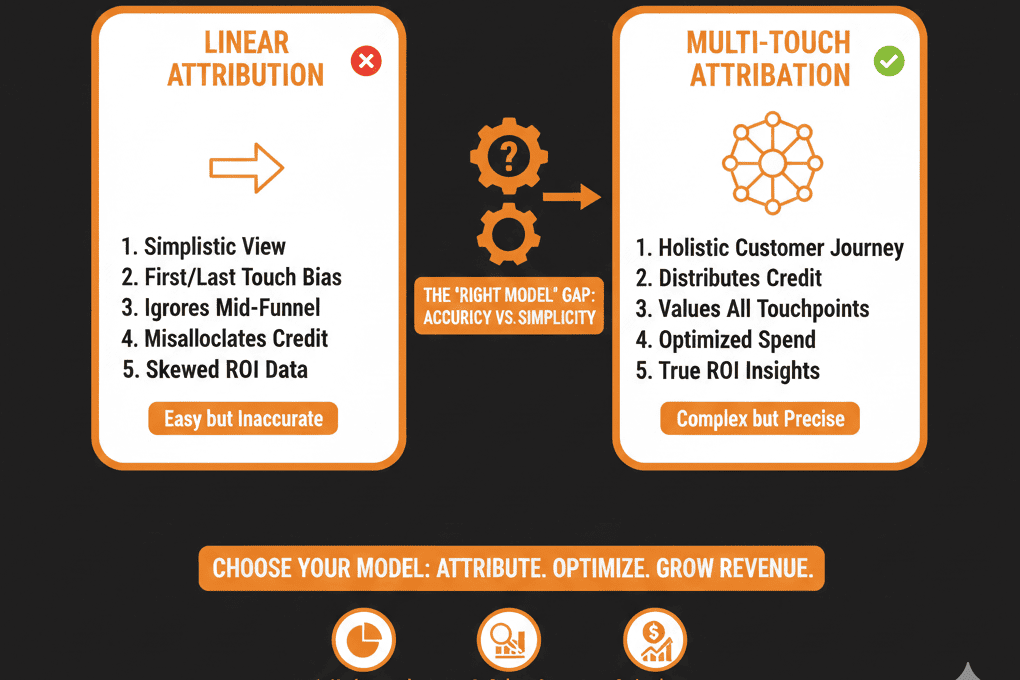
Here is the strategic breakdown of when to use Linear (Simplicity) and when to graduate to Multi-Touch (Precision) inside HubSpot.
📉 The "Linear" Model: The Great Equalizer
The Logic: Every touchpoint gets equal credit.
- A prospect clicks an Ad (25%).
- Reads a Blog (25%).
- Downloads an Ebook (25%).
- Books a Demo (25%).
When to Use It:
- Long, Educational Sales Cycles: If your product requires many touches, Linear prevents nurture content from being ignored.
- Brand Awareness Phase: When you’re building awareness, you want to reward any interaction.
The Fatal Flaw:
It creates "Vanilla Data." Because everything gets credit, nothing stands out, and budget decisions get fuzzy.
📈 The "Multi-Touch" Model: The SaaS Standard
The Logic: Credit is weighted based on impact.
In HubSpot, some deal/revenue attribution reporting is available only with Marketing Hub Enterprise.
Common models:
- W-Shaped: 30% to First Touch, 30% to Lead Creation, 30% to Deal Creation, and 10% split across the rest.
- Full Path: Adds weight to the last major conversion point (closed/revenue step) to reflect what actually finished the deal.
When to Use It:
- SaaS Growth Mode: You need to know what creates leads and what creates deals (not just clicks).
- High Ad Spend: If you spend >$10k/month on ads, you need to know if channels drive curiosity or revenue.
The Strategic Advantage:
It exposes the "Fake Heroes" by showing which channels consistently create leads and deals—not just traffic.
🧪 The "J-Curve" of Attribution Maturity
Don't jump to the complex model if your data is dirty.
Stage 1: First Touch (The Startup)
- Question: "How are people finding us?"
- Action: Invest in SEO and Social.
Stage 2: Linear (The Scale-Up)
- Question: "Is our content nurturing them?"
- Action: Invest in Blog and Email Nurture.
Stage 3: Multi-Touch (The Enterprise)
- Question: "What is the exact ROI of every dollar?"
- Action: Optimize the entire funnel using weighted attribution models.
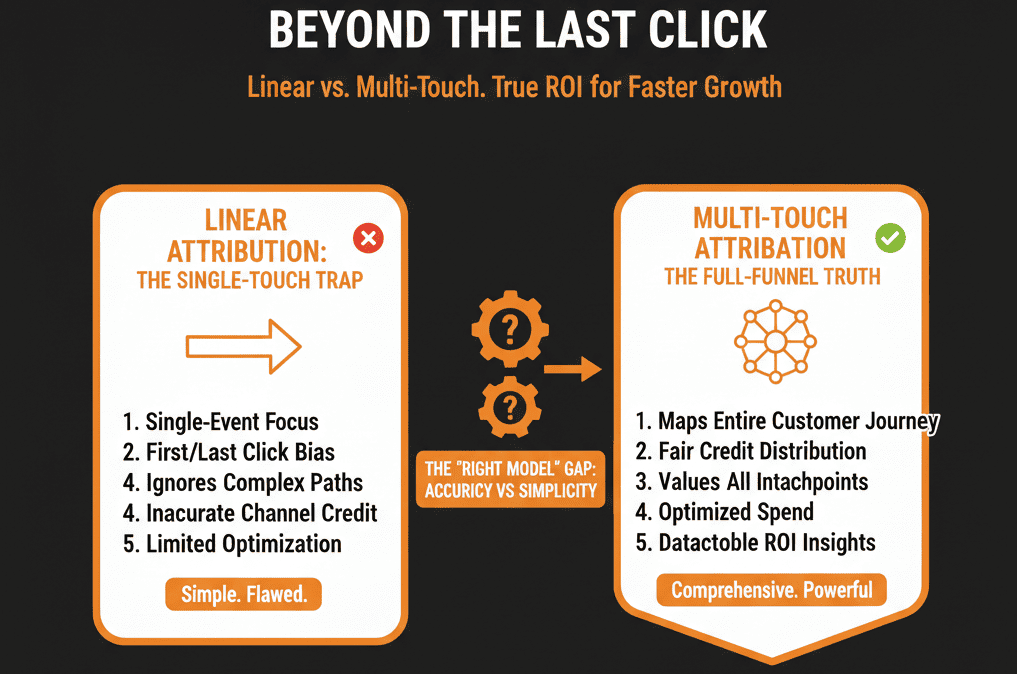
Attribution is an Opinion.
There is no "perfect" number. Attribution is simply a way of viewing the world.
Linear is an optimistic view ("Teamwork!").
Multi-Touch is a critical view ("Who did the work?").
For B2B SaaS, where CAC is the metric that kills you, you need the critical view. You cannot afford participation trophies.
Not sure if your "Interaction Sources" are tracking correctly?
This is part of our Free HubSpot Health Check.
We will audit your "Tracking Code" and "Campaign Tags." We'll run the side-by-side comparison of Linear vs. Multi-Touch to show you where your budget is actually going.