

🔩 Why "Out-of-the-Box" HubSpot Fails for B2B Manufacturers
Your B2B manufacturing company is not a SaaS startup.
A SaaS company worries about monthly recurring revenue (MRR) and 30-day sales cycles. You worry about 300-day sales cycles, complex distributor networks, capital equipment assets, and after-market service contracts.
Yet, most HubSpot portals are configured "out-of-the-box" for a simple SaaS sales motion. This is why your portal feels "broken." Your team finds it useless because it doesn't speak your language. It’s trying to fit your complex, physical-world business into a simple, digital-world box.
- How do you track a deal that has three stakeholders: an end-user, an engineering consultant, and a regional distributor?
- How do you manage a "lead" from a trade show that won't buy for 18 months?
- How do you connect a "service ticket" for a broken part back to the original "deal" from three years ago?
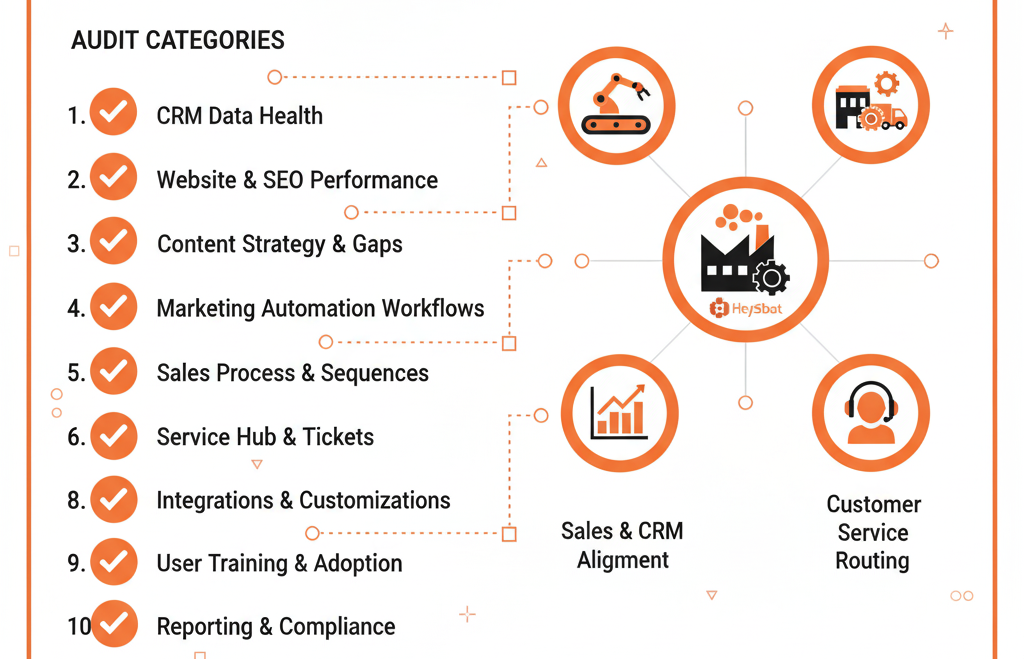
If your HubSpot portal can't answer these questions, it's not a "Revenue Machine"; it's a messy, expensive liability. For a VP of Sales or RevOps in manufacturing, you don't need generic advice. You need a system built for your reality. Here is the 10-point diagnostic checklist to see how your HubSpot portal really stacks up.
📋 The 10-Point HubSpot Audit Checklist
Use this checklist to self-diagnose your portal. A "No" on any of these points represents a significant revenue gap.
- 1. Are You Differentiating Distributors from End-Users?
This is the #1 failure. If your Company Type property is a free-text field (or doesn't exist), your database is a mess. You cannot market to, sell to, or report on "Distributors" and "End-Users" (your customers) in the same way.
Audit Check: Do you have a mandatory, dropdown Company Type property (e.g., Distributor, End-User, Specifier/Consultant, Supplier) on all Company records? - 2. Are You Tracking Assets with Custom Objects?
Your sales team doesn't just sell "products"; they sell "capital equipment" or "assets" that have a serial number, an install date, and a service history.
Audit Check: Are you using a HubSpot Custom Object (Pro/Enterprise) called "Assets" or "Installed Equipment"? Can you open a Company record and see a list of all the physical equipment they have purchased from you? If not, your Service and Sales teams are blind. - 3. Is Your Deal Pipeline Built for a 12-Month Cycle?
A SaaS pipeline is "MQL > Demo > Trial > Closed." A manufacturing pipeline is "Awareness > Specification > Engineering Review > Quote Revision > Legal > Closed."
Audit Check: Do your Deal Stages reflect your actual long-form sales process? Do you have "probability" weightings that reflect this long cycle, so your forecast isn't wildly optimistic? - 4. Are You Using the HubSpot Quotes Tool?
If your reps are still creating quotes in a Word doc or separate ERP and attaching them as a PDF, you have zero "quote" data in your CRM. You can't report on "Quote-to-Close Ratio" or see which line items are most popular.
Audit Check: Is your Product Library (with SKUs and pricing) built into HubSpot, and are your reps building Quotes directly from the Deal record? - 5. Do You Have a Separate Distributor Management Pipeline?
Your relationship with your distributors is not a "deal." You don't "close" them. You manage them. They have quarterly business reviews (QBRs), co-marketing plans, and performance goals.
Audit Check: Do you have a separate Deal Pipeline (or a custom "Partner" pipeline) to track your management activities with your distributor network, separate from your sales deals with end-users? - 6. Is Service Hub Connected to Your Assets?
When a customer calls for a replacement part, does your service team ask, "Can you read me the serial number?" That's a "Type B" (broken) system. In a "self-driven" system, the service rep opens the Company record, sees the "Asset" (Point #2), and already knows the serial number, warranty status, and service history.
Audit Check: When a Ticket is created in Service Hub, is it automatically associated with the "Asset" (Custom Object) and the "Company" record? - 7. Is Your Offline Lead Data Clean?
SaaS companies get 90% of their leads from web forms. Manufacturers get them from trade shows, distributor referrals, and phone calls. This "offline" data is notoriously dirty.
Audit Check: Do you have a standardized trade show import template? Do you have strict Lead Source governance (e.g., Trade Show > CONEXPO 2025) to track the real ROI of these expensive events? - 8. Are Your Marketing Campaigns Mapped to Engineers?
Your buyer isn't a 25-year-old "Marketing Manager." Your buyers are 55-year-old "Plant Managers," "Purchasing Agents," and "Specification Engineers." They don't want "growth hacks." They want PDF spec sheets, CAD drawings, and case studies on durability.
Audit Check: Have you built Personas in HubSpot for these technical buyers? Is your marketing content (blogs, emails) segmented and targeted to solve their specific, technical problems? - 9. Are You Automating the RFQ (Request for Quote) Process?
The RFQ-to-Quote handoff is a major friction point. A web lead fills out a complex "Request a Quote" form, and it lands in a generic "sales@" inbox. It then takes 48 hours for a rep to manually re-enter that data into the CRM.
Audit Check: Does your HubSpot "RFQ" form automatically create a Deal and a Task and assign it to the correct regional rep based on territory rules? This entire process should take 10 seconds, not 2 days. - 10. Can Your Dashboards Answer Revenue Questions?
Your dashboard shouldn't just show "Deals Created." It needs to answer complex business questions.
Audit Check: Can you, in 30 seconds, pull a report that shows:
- "Sales Revenue by Product Line"?
- "Quote-to-Close Ratio by Sales Rep"?
- "Deal Volume by Distributor"?
- "Service Tickets Created by Asset Type"?
If the answer is no, your data is unreliable.
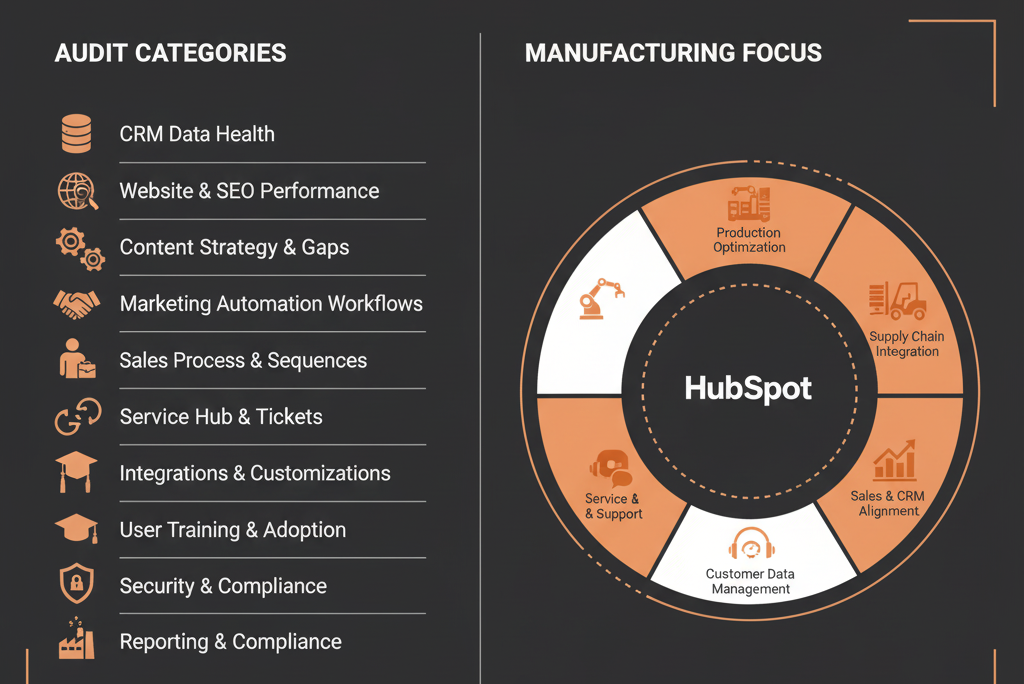
🩺 Your Audit Score: From "Generic" to "Manufacturing Machine"
1-2 "No" Answers: You have some gaps, but your foundation is solid. You need optimization.
3-5 "No" Answers: Your portal is causing significant friction and data silos. You are "leaking" revenue and service opportunities.
6+ "No" Answers: Your HubSpot portal is a generic SaaS tool that is actively hurting your manufacturing business. It’s time for a strategic overhaul.