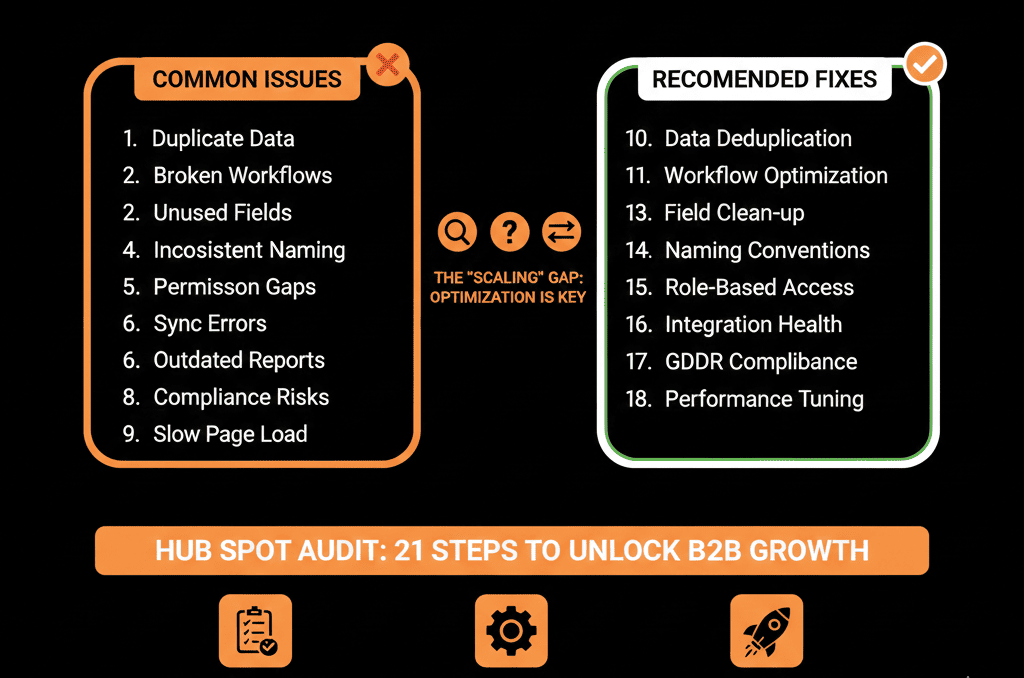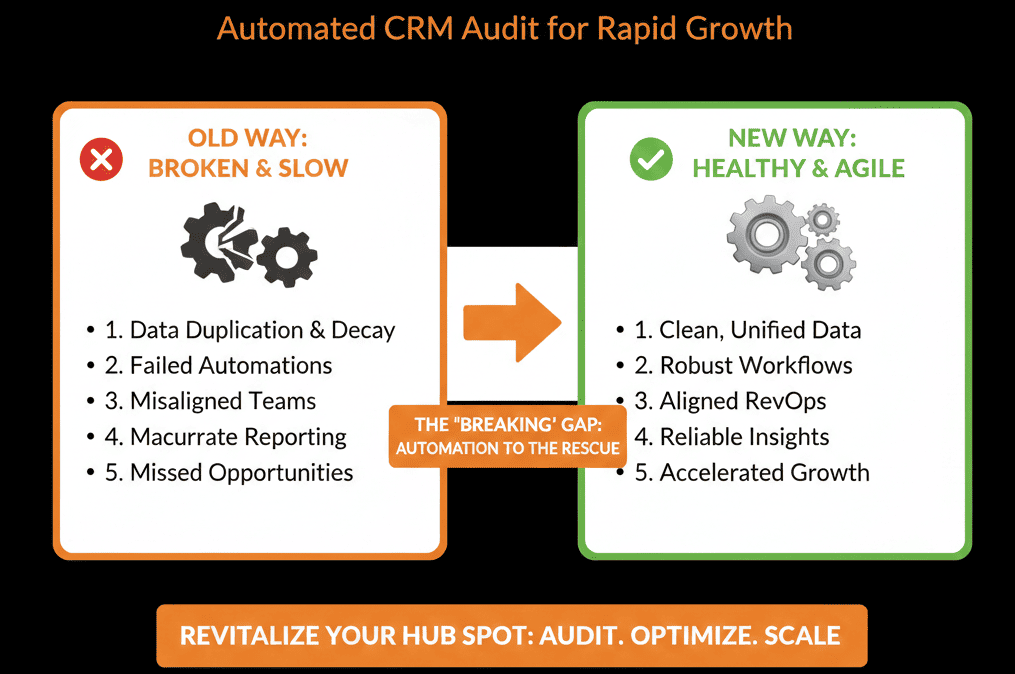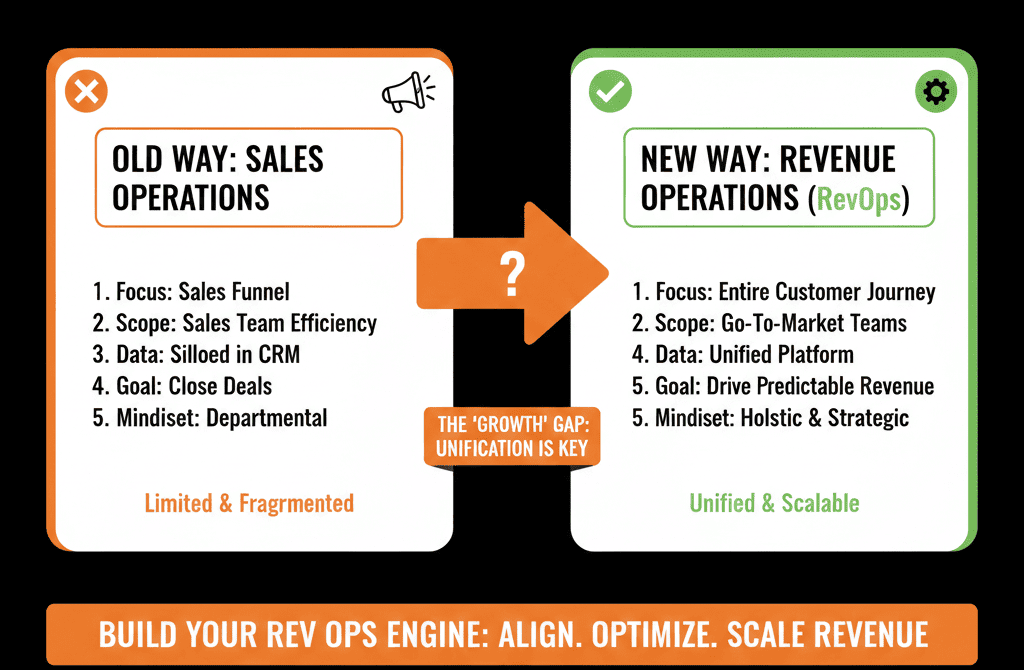


How to Use This HubSpot Audit as a CEO
You don’t need to be “the HubSpot person” to know if your portal is helping or hurting revenue. You just need a simple, ruthless checklist.
- Share this with your RevOps, marketing, or sales leader.
- Have them score each item Green / Yellow / Red and send you a one-page summary.
In under an hour, you’ll know whether you need:
- A few fixes.
- A focused HubSpot Health Check.
- Or a deeper re-architecture.
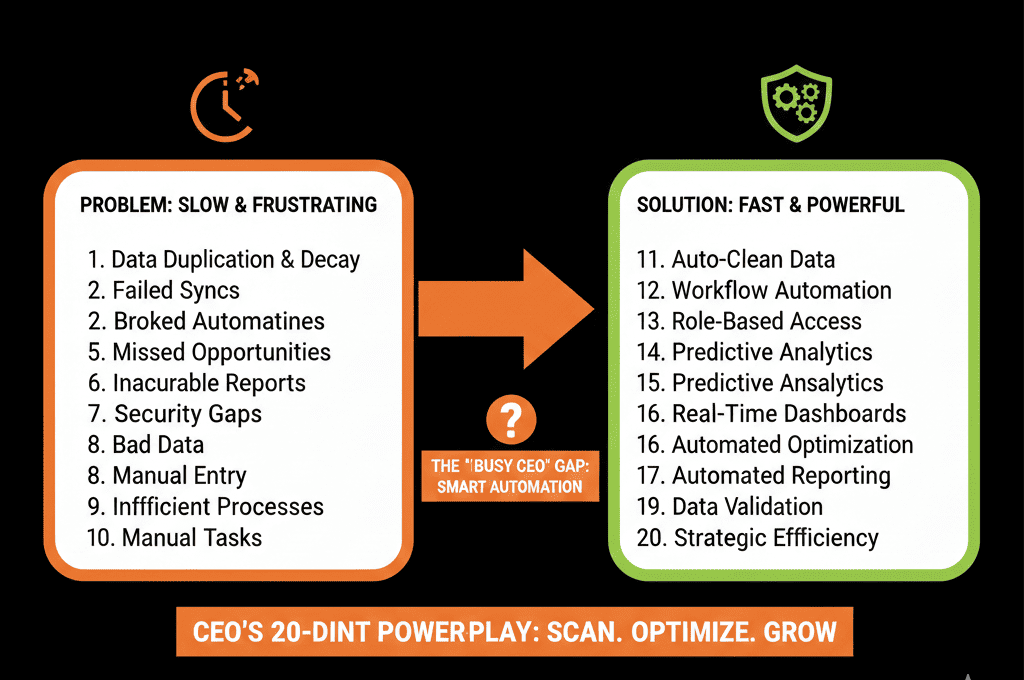
Section 1 – Strategy & Ownership (3 Checks)
These checks tell you whether HubSpot has a clear owner and purpose.
1) Clear business outcome for HubSpot
Question: Can your team state in one sentence what HubSpot is supposed to deliver for the business?
Example: “HubSpot is our single source of truth for pipeline and revenue, used daily by sales, marketing, and CS.”
Red flag: Different answers from sales, marketing, and leadership.
2) Defined HubSpot owner and architect
Question: Is there a named person who owns HubSpot adoption, data quality, and configuration decisions?
Red flag: “Everyone and no one” owns HubSpot; changes happen ad hoc.
3) Documented governance rules
Question: Do you have written rules for who can create properties, pipelines, workflows, and reports?
Red flag: Anyone with access can create fields or automation; no review process.
Section 2 – Data & Properties (5 Checks)
These checks show whether your CRM data is trustworthy.
4) Contact and company duplicates under control
Ask for a quick export or screenshot: How many duplicate contacts and companies exist?
- Green: Duplicates are monitored and merged regularly (HubSpot provides duplicate management inside Data Quality).
- Red: Thousands of obvious duplicates; teams complain about “messy data.”
5) No property bloat for key objects
Question: How many custom properties exist for Contacts, Companies, and Deals?
Follow-up: How many are actually used in views, workflows, and reports?
Red flag: Hundreds of fields nobody can explain or connect to a process.
6) Standard naming conventions
Ask to see property lists: Are names consistent and readable (e.g., “Lead source (primary)” vs “lsrc_1”)?
Red flag: Multiple fields for the same concept (e.g., “Job Title,” “Title,” “Role”) with no clarity.
7) Critical data captured by design, not luck
Question: For every new deal and customer, are these always populated in HubSpot?
- Segment / ICP.
- Region.
- Source / Channel.
- Owner.
- Expected or actual value.
Red flag: Leadership can’t filter pipeline or revenue by these basics.
8) Clear source-of-truth integrations
Question: Is it clear which system is the source of truth for:
- Revenue (MRR/ARR/contract value).
- Product usage (if SaaS).
- Billing status.
Red flag: Conflicting numbers between HubSpot, finance tools, and internal sheets.
Section 3 – Lifecycle, Pipelines & Handoffs (6 Checks)
These checks show whether HubSpot reflects how you actually win and keep customers.
9) One shared lifecycle model
Ask leadership and GTM leads: How do you define Lead, MQL, SQL, Opportunity, and Customer?
Green: Consistent definitions, documented and reflected in HubSpot.
Red: Each team gives a different answer, and HubSpot fields don’t match reality.
10) Rational number of deal pipelines
Question: How many active deal pipelines do you have?
For most scaling B2B teams, 1–3 is healthy (New Business, Expansion/Renewal, maybe Partner).
Red flag: Many pipelines for edge cases; reporting becomes hard.
HubSpot supports multiple pipelines, but more pipelines should reflect real motions—not workarounds.
11) Clear stage exit criteria
Ask for one pipeline and review the stages: Can the owner explain exactly when a deal moves from one stage to the next?
Green: Each stage has yes/no criteria.
Red: “It depends,” and reps interpret stages differently.
12) Leads never “live in limbo”
Question: What happens when a new qualified lead appears in HubSpot?
- Is a task or deal automatically created and assigned?
- Is there a clear SLA for first response?
Red flag: Leads sit in forms or lists; follow-up relies on manual checking.
13) Sales → CS/Service handoff in HubSpot
Ask: When a deal is marked Closed Won, what happens inside HubSpot?
Green: Tickets or onboarding work are created with key context; CS is notified automatically.
Red: Handoffs happen in Slack/email, not in HubSpot.
14) Renewals and expansion are tracked as formal work
Question: How do you track renewals and upsells?
Red flag: Renewal dates live in spreadsheets or billing tools only.
Section 4 – Activity, Adoption & Usage (3 Checks)
These checks answer whether people actually use HubSpot daily.
15) Reps live in HubSpot, not spreadsheets
Ask your Head of Sales: Do reps manage their pipeline directly in HubSpot, or in side spreadsheets?
Red flag: “We export from HubSpot, then work from Excel.”
16) Logged activity reflects reality
Look at a sample of accounts and deals: Do you see recent calls, emails, notes, and meetings logged?
Green: HubSpot shows a clear timeline of interactions.
Red: Timelines are empty or missing key meetings.
17) Marketing, sales, and CS all log into HubSpot weekly
Ask each leader: “What do you open in HubSpot every week?”
Red flag: One or two teams use HubSpot; others avoid it.
Section 5 – Reporting & Forecasting (3 Checks)
These checks reveal whether leadership can trust HubSpot to make decisions.
18) Single source of truth for revenue and pipeline
Ask your CFO and CEO: Which system do you open for current pipeline/forecast and booked revenue?
Green: HubSpot is at least the starting point.
Red: HubSpot is bypassed; executives pull from finance systems and sheets only.
19) Executive dashboards that drive decisions
Ask to see the top 3 dashboards:
- Are they used in leadership meetings?
- Can they answer: “Where is growth coming from?” “How healthy is our pipeline?” “Where are we leaking?”
Red flag: Dashboards exist but aren’t trusted.
20) Forecast vs actuals alignment
Look at the last 3 months/quarters: How close was the HubSpot forecast to actual closed revenue?
Green: Within a reasonable range with clear explanations.
Red: Regular surprises; forecasts are treated as fiction.
How to Turn This Checklist into a One-Page CEO Summary
You don’t need to dig into settings yourself. Ask your RevOps/marketing/sales leader to:
- Score each point Green / Yellow / Red.
- Add 1–2 sentences of evidence per red item.
- Propose the three highest-impact fixes for the next 30–90 days.
Your summary back should look like:
- Overall status: Mostly Yellow with 6 Red items.
- Top issues: No clear lifecycle definitions; inconsistent handoffs, property bloat and missing core deal data, dashboards not trusted.
- Next 90 days: Redesign lifecycle + handoffs, standardize key properties, rebuild executive dashboards from clean data.
From there, you decide if your team owns the fix internally or if you bring in a HubSpot specialist.
When This Audit Signals You Need External Help
You should strongly consider a structured portal audit if:
- More than 5 items are Red (especially lifecycle/pipelines, data/properties, reporting/forecasting).
- Leadership doesn’t trust HubSpot numbers in key meetings.
- You’re planning to scale headcount or spend, but your CRM foundation is shaky.
- Your team is already at capacity and can’t redesign architecture while running day-to-day operations.
In those cases, an external HubSpot architect can:
- Translate your revenue strategy into a stable HubSpot design.
- Run a deeper, configuration-level review (including data quality + duplicate management).
- Deliver a phased roadmap that improves the portal without breaking daily work.
Get a Diagnostic (Not Just a Checklist)
This checklist is designed to surface problems fast. Turning it into a scalable HubSpot system usually takes more than quick wins—because reporting, routing, and forecasting depend on clean, governed data.
Our team at ElanceMind runs focused HubSpot Portal Health Checks for CEOs and RevOps leaders who want:
- A clear Green/Yellow/Red view of the current portal.
- A prioritized, revenue-first roadmap for the next 30–90 days.
- Hands-on help implementing fixes without disrupting the team.