

Most Revenue Leaks Happen Between Marketing and Sales
If you’re hearing:
“We send great leads; sales just doesn’t follow up.”
“Marketing’s leads are junk.”
“We don’t know what happens after MQL.”
…the problem is usually not people.
It’s the handoff architecture inside HubSpot.
The good news:
You can diagnose the biggest issues in one afternoon if you know where to look.
This article walks through a 3–4 hour, step-by-step audit of your Marketing–Sales handoff in HubSpot so you can:
- Find the real leaks.
- See where process and configuration disagree.
- Prioritize fixes that actually move revenue.

Overview: The 4-Part Handoff Audit (3–4 Hours)
You’ll inspect four key areas:
- Definitions & lifecycle (30–45 minutes)
- Lead routing & SLAs (60–90 minutes)
- Rep follow-up behavior (45–60 minutes)
- Reporting & feedback loops (30–45 minutes)
You don’t need to fix everything today.
You just need to come out with clarity and a short, high-impact fix list.
Part 1 – Clarify Definitions and Lifecycle (30–45 Minutes)
Start with definitions, not dashboards.
1.1 Get agreement on basic terms
Sit down (physically or virtually) with one marketing and one sales leader and ask:
- What is a Lead for us?
- What is an MQL?
- What is an SQL?
- What is an Opportunity?
For each, capture:
- Criteria (fit + behavior).
- Who owns it (Marketing/SDR/AE).
- What should happen next (SLA / follow-up).
You’ll likely find misalignment immediately—note it, but don’t solve it yet.
1.2 Compare definitions to HubSpot lifecycle logic
Open HubSpot and inspect:
- Lifecycle stage options in your portal.
- Workflows that set or change Lifecycle stage.
Questions:
- Do MQL/SQL/Opportunity stage changes in HubSpot match what leaders just said?
- Are there multiple workflows updating Lifecycle in conflicting ways?
- Can reps manually override Lifecycle freely?
Deliverable from Part 1:
A short note:
“Our current HubSpot lifecycle does/does not match how we say we work.”
Specific gaps (e.g., “MQL is based solely on form fills, not ICP fit”).
Part 2 – Audit Lead Routing & SLAs (60–90 Minutes)
Now examine what happens to leads at the moment they should move from Marketing to Sales.
2.1 Map your high-intent entry points
List your main high-intent sources:
- “Request Demo” / “Talk to Sales” forms.
- Pricing, contact, or trial requests.
- High-intent content (ROI calculator, product comparison).
- Sales-assigned outbound forms or reply addresses.
For each, document:
- Which form/CTA is used.
- Where it lives (URL/page).
- What should happen when it’s submitted.
2.2 Test the actual experience
In a test or non-critical environment (or using a dummy contact):
Submit each high-intent form.
Watch what HubSpot does:
- Does a contact get created or updated?
- Does Lifecycle change?
- Is Lead status set to New?
- Is an owner assigned?
- Is a task created with a due date?
- Are there any notifications (email/Slack)?
Write down the journey for each entry point.
2.3 Check routing workflows
Open workflows responsible for:
- Lead intake.
- Lead assignment.
- Notifications/SLAs.
Ask:
- Are routing rules simple and understandable (by brand, region, segment)?
- Are some leads falling outside all routing criteria (no owner, no task)?
- Does routing differ by form in ways no one remembers?
2.4 Measure current SLA performance
Quick checks:
Create a report or view for new high-intent leads in the last 7–30 days:
- How many have no associated activity (call, email, meeting)?
- How long between lead creation and first activity?
If you have Time to first response or similar:
- Check average and distribution.
Deliverable from Part 2:
A clear picture of:
- Which leads are correctly routed and worked.
- Which segments or forms leak (no owner, no tasks, or slow response).
Part 3 – Review Rep Follow-Up Behavior (45–60 Minutes)
Now we look at human behavior inside the system.
3.1 Inspect a sample of MQLs or handoff-ready leads
Take a random sample of 20–30 leads that:
Became MQLs or reached your handoff criteria in the last 30 days.
For each, check:
- Did Sales (SDR/AE) accept or reject the lead explicitly (via Lead status or similar)?
- Was there at least one call or email logged?
- If rejected/unqualified, is the reason clear?
- If accepted, did they create a deal where appropriate?
Patterns to look for:
- Leads left in “New” or “MQL” with no actions.
- Reps using Lead status inconsistently (e.g., “Bad Fit” vs “Nurture” vs leaving as New).
- Deals created but not associated correctly.
3.2 Compare top performers vs laggards
Look at:
1–2 top SDRs/AEs.
1–2 average or struggling reps.
Compare:
- Speed to first touch.
- Activity frequency in the first 7–14 days.
- How they use Lead statuses and deal creation.
This shows whether you have:
- A process/architecture problem (everyone is inconsistent).
- A training/management problem (some reps follow the process, others don’t).
Deliverable from Part 3:
A short summary of:
“Here’s how handoffs actually play out in the field.”
Specific rep behaviors and patterns to support or correct.
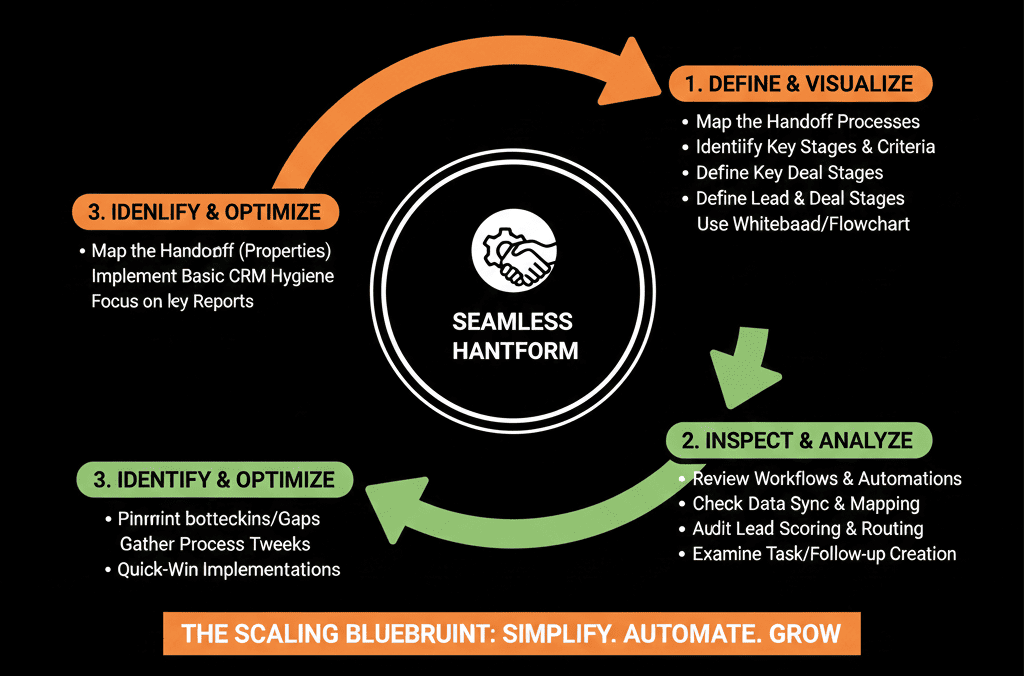
Part 4 – Check Reporting & Feedback Loops (30–45 Minutes)
Finally, see whether Marketing and Sales have a shared view of the handoff.
4.1 Review key handoff reports
Look for or create:
- MQL → SQL → Opportunity funnel report.
- MQL to first-touch SLA performance.
- Conversion by lead source or campaign.
Ask:
- Do both Marketing and Sales look at these regularly?
- Are they trusted, or do people work off their own spreadsheets?
- Are definitions used in reports aligned with what you heard in Part 1?
4.2 Look for missing or misleading metrics
Common gaps:
- No report showing “Accepted vs Rejected MQLs by reason.”
- No visibility into “Leads with no activity after X days.”
- No clear view of “Pipeline and revenue generated by Marketing-sourced leads.”
Write down:
Which metrics/visuals would actually help both teams have constructive conversations (vs blame).
Deliverable from Part 4:
A list of 2–3 handoff KPIs you should be tracking in shared dashboards.
Turning Your Handoff Audit Into a Fix Plan
By now, you should have:
- Clear misalignments in definitions (MQL/SQL/opportunity).
- Specific routing leaks (unassigned leads, missing tasks).
- Evidence of rep follow-up gaps.
- Reporting blind spots.
Next steps (over 30–60 days):
Align on definitions
- Lock in MQL, SQL, and Opportunity definitions and write them down.
- Update lifecycle logic and documentation accordingly.
Fix routing and SLAs for high-intent leads first
- Ensure all demo/contact sales leads: Get an owner. Get a task with a due date. Are visible in shared SLA dashboards.
Standardize Lead status usage
- Define statuses (New, In Progress, Qualified, Unqualified, Nurture).
- Train reps; coach off this in 1:1s and pipeline reviews.
Build a small, shared handoff dashboard
Marketing + Sales both use it weekly to:
- Review volume, quality, and follow-up.
- Adjust campaigns and processes together.
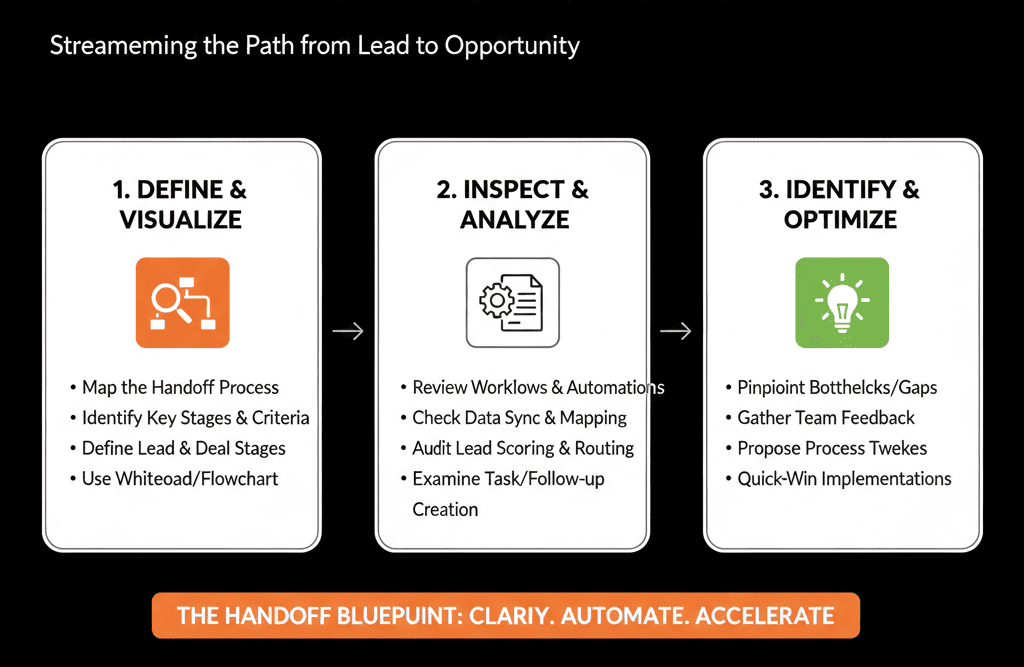
What You Can Do This Week (One-Afternoon Version)
If you only have one afternoon:
- Pick one high-intent form (e.g., Request Demo).
- Trace 10 recent leads from that form end-to-end: Entry → routing → SLA → follow-up → outcome.
- List every place the process broke or was unclear: Lifecycle stage missing or wrong. No owner. No activity. No clear status or feedback.
- Share a 1-page summary with Marketing and Sales: “Here’s what’s working.” “Here’s where we’re losing leads.” “Here are 3 changes we can make in the next 30 days.”
This single-path audit often surfaces 80% of your actual handoff issues.
Want Help Running a High-Impact Handoff Audit in Your Portal?
If your Marketing–Sales relationship is strained and both sides are pointing at HubSpot as the problem, a neutral, structured audit can reset the conversation.
Our HubSpot Portal Health Check / HubSpot Audit can be aimed specifically at the handoff layer:
- Review lifecycle logic, routing workflows, and SLAs.
- Analyze MQL/SQL/opportunity flow and follow-up behavior.
- Deliver a clear, prioritized plan to fix the biggest revenue leaks between Marketing and Sales.