

Founder-Led Sales Breaks First in the CRM
In founder-led teams, HubSpot usually looks like this:
- The founder has their own way of tracking deals.
- Early reps copy pieces of that, plus their own habits.
- Marketing is just starting to generate leads.
- Reporting exists, but nobody fully trusts it.
At 3–5 reps, this is survivable.
At 8–15 reps, things start breaking:
- Deals go missing or get double-worked.
- Follow-up is inconsistent.
- Revenue becomes unpredictable.
The fix is not just “more training.”
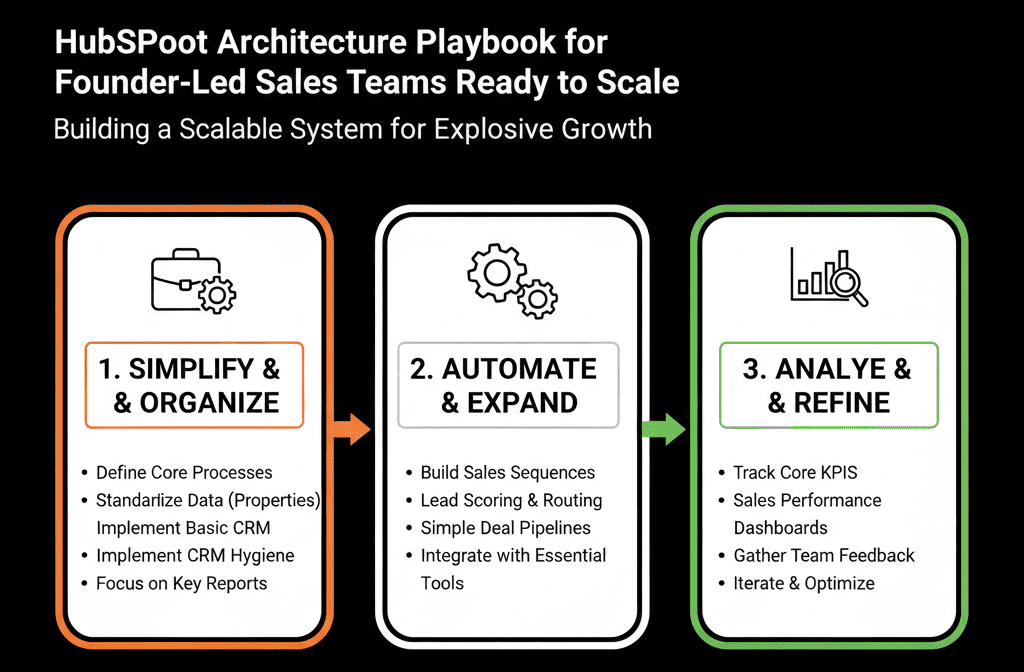
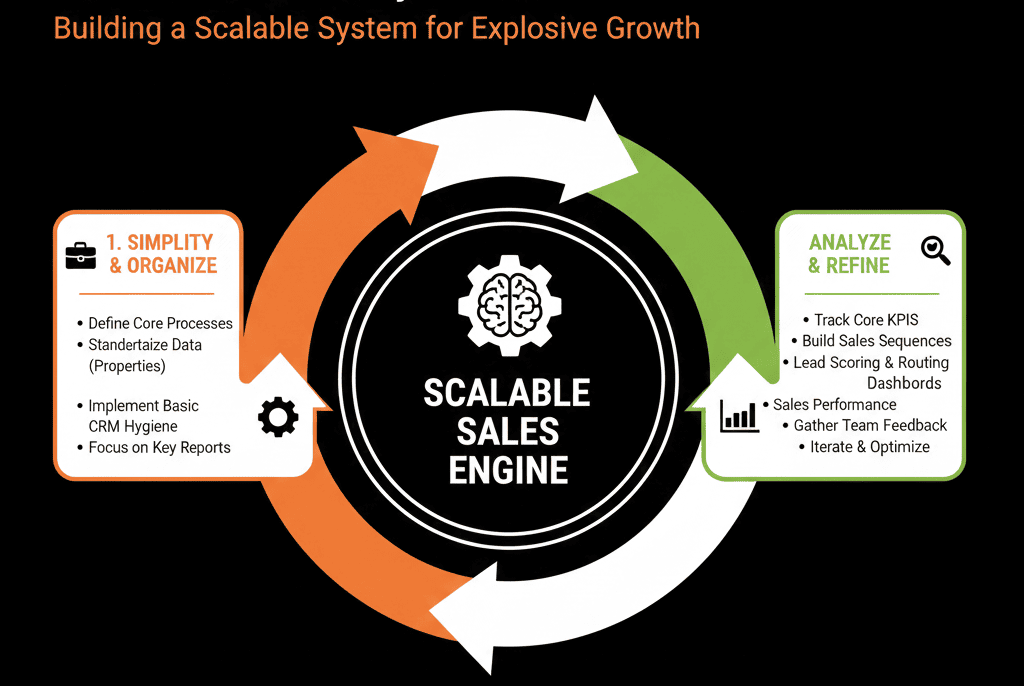
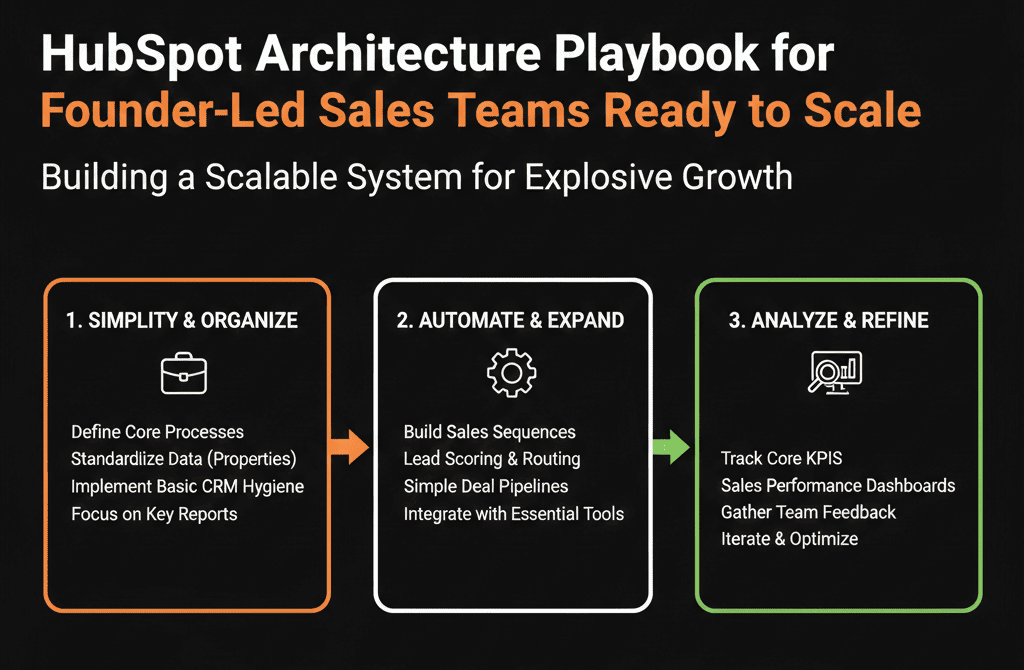
It’s an intentional HubSpot architecture that captures what worked in founder-led sales and makes it repeatable for a growing team.
This playbook shows how we design that architecture.
Step 1 – Capture the Founder’s Real Process (Not Their Stories)
Founders often say “there is no process; I just sell.”
In reality, they:
- Ask certain questions every time.
- Follow a rough sequence of steps.
- Look for specific signals before committing time.
We sit with the founder and ask:
- How do you find or receive prospects today?
- What makes you decide a prospect is worth your time?
- What are the biggest reasons deals stall or die?
- What are the key milestones from first call to Closed Won?
We then:
Turn those into a simple founder journey map:
- Inbound/outbound discovery
- Qualification
- Deeper discovery / solutioning
- Proposal
- Decision
- Close / onboard
This becomes the basis for pipelines, fields, and automations.
Step 2 – Design a Simple, Realistic Pipeline Around That Journey
We want one primary new-business pipeline that matches how customers buy—not how internal titles work.
Example starter pipeline for founder-led teams:
- New / To Triage – Inbound or outbound lead; not yet qualified.
- Qualified – Confirmed pain, rough fit, agreed next step.
- Discovery / Deep Dive – Understanding use case, stakeholders, timeline.
- Proposal / Quote Sent – Solution and pricing shared.
- Negotiation / Review – Terms, legal, final details.
- Verbal Commit (optional) – They’ve said yes, paperwork pending.
- Closed Won / Closed Lost
For each stage, we:
- Define entrance/exit criteria that match what the founder actually does.
- Add the minimum required fields at later stages (amount, close date, key contact, use case).
This gives new reps a realistic, founder-approved map to follow.
Step 3 – Build a Minimum Viable Data Model for ICP and Deals
Scaling sales means:
Not every inbound or outbound contact deserves the same level of effort.
You need to know who fits your Ideal Customer Profile (ICP).
We define a minimum viable set of properties:
Contacts
- Job title
- Role in buying (Decision Maker / Champion / User / Other)
- Department
- Country/region
- Persona (if you use them)
Companies
- Industry
- Company size (employee band)
- Region
- ICP tier (A/B/C or Fit / Borderline / Poor)
Deals
- Primary use case or problem
- Segment (SMB/MM/Enterprise or your bands)
- Product/line of business (if multiple)
We don’t overcomplicate.
We only add fields that:
- Help with prioritization and routing, or
- Fuel reporting that leadership will actually use.
Step 4 – Set Up Lead Management That Matches Founder Expectations
Founder-led teams often have:
- Leads going directly to the founder’s inbox.
- Ad-hoc forwarding to reps.
- No clear tracking of what went where.
We move this into HubSpot with a simple lead management architecture:
Map all lead sources:
- Website demo/contact forms.
- Inbound content (guides, webinars).
- Outbound lists and responses.
- Referrals and partner leads.
Standardize intake:
All leads enter HubSpot with:
- Lifecycle = Lead or MQL (depending on their intent).
- Lead status = New.
- Basic ICP fields captured.
Routing:
Founder may still get certain strategic or large deals:
Use a rule like Segment = Enterprise or Deal size > X.
Other leads route to SDRs/AEs via round robin or territory.
SLAs:
Define and enforce simple rules:
- High-intent leads: first touch within X hours.
- Other leads: first touch within Y days.
We then:
- Use workflows for routing and SLAs.
- Build views:
- “Unworked new leads”
- “Founder-owned strategic leads”
This keeps founder oversight where it matters while enabling reps to handle volume.
Step 5 – Implement a Lightweight Qualification Framework in HubSpot
At founder-led scale, full MEDDIC may be overkill—but zero structure is risky.
We help teams codify core qualification in HubSpot, based on how the founder thinks.
Example fields on Deals:
- Fit score (Good / Okay / Poor).
- Pain clarity (Low / Medium / High).
- Budget clarity (Unknown / Discussed / Confirmed).
- Authority identified? (Yes/No).
- Timeline (This quarter / Next quarter / 6+ months).
We:
- Place these fields prominently in the deal layout.
- Encourage filling them during discovery.
- Use them in pipeline reviews to coach reps.
This makes founder instincts more visible and teachable to new hires.
Step 6 – Create a Simple, Shared Reporting Layer for the Founder and Team
Founders don’t need 20 dashboards. They need a few key views:
Pipeline & forecast dashboard
- Open pipeline by stage.
- Forecast vs target (even if targets are rough).
- Top deals the founder should watch or support.
Lead and opportunity flow dashboard
- New leads and opps per week/month.
- Conversion from lead → opp → customer.
- Source/segment breakdown.
Rep activity and performance dashboard
- Deals owned per rep.
- Win rates and cycle lengths.
- Basic activity metrics (calls, emails, meetings).
We ensure:
- Metrics match the language the founder already uses (“How many serious deals this month?” vs vague “SQLs”).
- Dashboards are simple enough to use in a weekly revenue meeting.
This anchors the new architecture to regular founder visibility and decisions.
Step 7 – Introduce Governance Slowly (But Clearly)
Founder-led teams resist heavy process. That’s understandable.
But some guardrails are non-negotiable as you scale.
We recommend:
One person as HubSpot owner / RevOps lite:
Could be founder, operations manager, or senior seller initially.
Responsible for approving new properties, workflows, and pipelines.
Basic rules:
- No one creates arbitrary fields without approval.
- No one changes deal stages or deletes workflows casually.
- Any major change to lifecycle, routing, or pipelines is: Tested. Documented. Communicated.
A light monthly review:
- Are leads being worked within SLAs?
- Are deals updated consistently?
- Are dashboards still matching founder’s mental model?
This is enough governance to avoid chaos without bogging the team down.
Step 8 – Turn the Playbook Into a 60–90 Day Implementation Plan
To actually implement this architecture, we break it into phases.
Phase 1 (Weeks 1–3): Foundations
- Capture founder process.
- Design and configure pipelines and required fields.
- Set up minimum viable data model.
- Build core views for founder and reps.
Phase 2 (Weeks 4–6): Lead management & qualification
- Map lead sources.
- Implement routing workflows and SLAs.
- Add core qualification fields and train reps.
Phase 3 (Weeks 7–9): Reporting & governance
- Build founder-ready dashboards.
- Align on metrics and definitions.
- Formalize basic governance and documentation.
By the end, HubSpot:
- Reflects how the founder wants to sell.
- Is usable by new reps without constant hand-holding.
- Gives leadership a real view of pipeline and performance.
What You Can Do in the Next 30 Days
If you’re a founder-led team ready to scale:
- Spend 60–90 minutes mapping your current sales journey with the founder.
- Redesign your main new-business pipeline to match that journey.
- Define must-have fields for deals and contacts (fit, pain, budget, timeline).
- Set up basic lead routing and SLAs for your highest-intent leads.
- Build one simple Founder / CEO dashboard showing: Pipeline by stage. New deals created. Top deals this month.
You can evolve everything else later. These steps alone create a much stronger foundation.
Want Help Turning Founder Intuition Into a Scalable HubSpot Architecture?
If your current HubSpot setup is a partial reflection of how the founder sells—but doesn’t yet support a growing team—this is the exact moment when a small architectural investment has outsized returns.
Our HubSpot Portal Health Check / HubSpot Audit for founder-led teams:
- Extracts the founder’s real sales process.
- Translates it into a clean HubSpot architecture (pipelines, fields, routing, dashboards).
- Delivers a 60–90 day implementation roadmap tailored to your team size and growth goals.