

Why Some HubSpot Portals Quietly Outperform Others
On paper, many teams have the same HubSpot licenses.
Same tools. Same features.
But outcomes could not be more different.
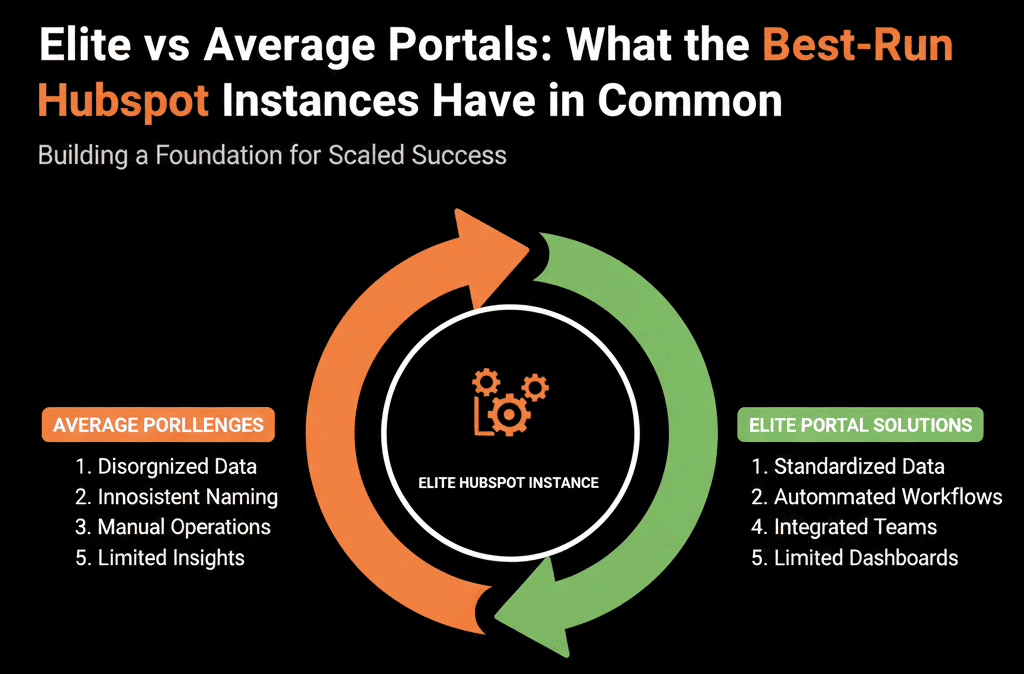
In elite portals:
- Reps trust the data.
- Leaders make decisions directly from dashboards.
- Changes ship quickly without chaos.
- Revenue operations compounds instead of constantly resetting.
In average portals:
- No one is quite sure if reports are accurate.
- Teams work around HubSpot in Sheets and side tools.
- Every change feels risky and political.
- Audits are painful, rare, and always overdue.
The difference is rarely budget.
It is discipline and design.
Our team at ElanceMind has audited and rebuilt a wide range of HubSpot instances.
Certain patterns repeat.
We will walk through the characteristics we see consistently in elite portals, so you can benchmark your own.
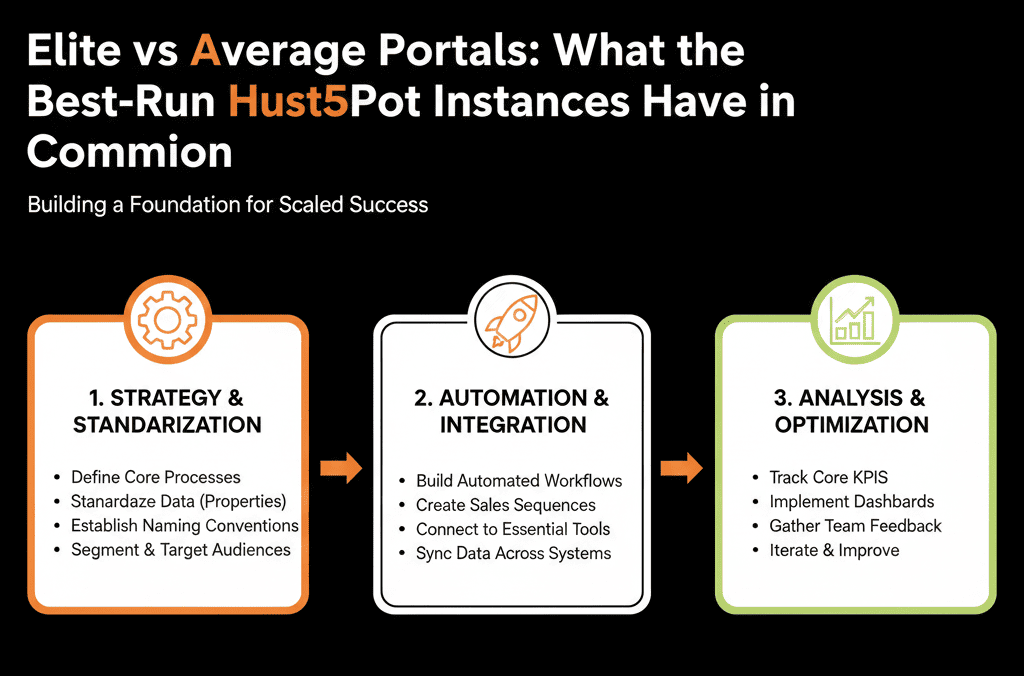
1. Elite Portals Have a Ruthlessly Clear Data Model
Average portals “grow” their data model organically.
Every new question becomes a new property.
Soon you have hundreds of fields, partial duplicates, and no one really knows which to use.
Elite portals do something very different:
- They treat the data model as architecture, not admin work.
- They define the role of each core object (Contacts, Companies, Deals, Tickets, custom objects).
- They give every important property a clear purpose, owner, and naming convention.
- They document what key fields mean and when they must be updated.
In practice, this looks like:
- A short, opinionated set of lifecycle and status properties.
- Clear account-level vs contact-level data separation.
- A controlled process for creating new properties, with review and naming standards.
- A living data dictionary that GTM and RevOps can understand.
Result: people can answer questions faster.
Reporting is consistent.
Integration decisions become easier because you know exactly where new data should live.
2. Elite Portals Encode GTM Strategy, Not Just Tool Features
Average portals start from “what can HubSpot do?”
They toggle features on and configure around menus.
Elite portals start from “how do we actually go to market?” and then encode that:
- ICP and segments are reflected in properties, lists, and routing.
- Inbound, outbound, partner, and product-led motions have distinct but connected flows.
- MQL, SQL, and opportunity definitions are agreed across Sales, Marketing, and CS, then implemented precisely.
Three signals you are closer to “elite” here:
- When GTM strategy changes, you know exactly which parts of HubSpot must change.
- Sales and Marketing describe qualification the same way leadership does.
- There are minimal “shadow systems” outside HubSpot trying to replicate stages or lifecycle.
HubSpot is not just a database.
In elite setups, it is the operating layer of your GTM motion.
3. Elite Portals Are Governed, Not Free-for-All
Average portals are full of well-meaning one-off changes:
- New properties added without review.
- New workflows built to “just fix this one use case.”
- Integrations installed without a clear data contract.
Over time, the portal becomes fragile.
Everyone is afraid to touch it.
Elite portals have lightweight but real governance:
- Clear roles: who can create workflows, properties, lists, and reports.
- A simple approval path for significant changes, with a reason, owner, and test plan.
- Standard naming conventions for automation, lists, and views.
- Regular reviews of old assets (workflows, lists, forms, dashboards) to archive or refactor.
Governance here does not mean bureaucracy.
It means you can answer, at any point:
- Who built this?
- What does it do?
- What depends on it?
- Who owns it now?
That clarity is what separates portals that age well from those that rot.
4. Elite Portals Use Automation as Plays, Not Just Triggers
Average portals measure success by volume of automation.
Every problem becomes a workflow.
Names do not match intent.
No one is fully sure what will fire next.
Elite portals treat automation as codified plays, tied directly to revenue outcomes:
- Lead nurture workflows map to specific segments, pain points, and lifecycle moments.
- SDR and AE task creation is intentional, with clear priorities and SLAs.
- CS workflows support onboarding, adoption, renewal, and expansion with defined triggers and outcomes.
Inside an elite portal, you can pick any important workflow and answer:
- Which play or motion does this represent?
- What is the hypothesis behind it?
- How do we know if it is working?
- When was it last reviewed?
Automation is not there to “look advanced.”
It is there to run the same high-quality plays at scale.
5. Elite Portals Make Reporting Boring and Trusted
Average portals have dozens of dashboards.
Multiple versions of “the same” metric.
Leaders ask for exports because they do not quite trust what they see.
Elite portals do fewer things, better:
- Core dashboards are role-based: leadership, RevOps, Sales manager, CSM, marketer.
- Definitions for key metrics (pipeline, MQL, NQL, SQL, win rate, NRR) are written down and agreed.
- Data quality rules underpin each report so numbers do not drift quietly.
This creates a virtuous loop:
- Teams use dashboards daily because they actually answer real questions.
- Leaders ask more nuanced questions because basics are solid.
- Audit cycles get easier because the system is designed for visibility from day one.
When we see leadership teams make board decisions directly from HubSpot dashboards, we know we are in “elite” territory.
6. Elite Portals Bring Sales, Marketing, and CS into One Revenue System
Average portals treat post-sale as an afterthought:
- Onboarding lives in another tool.
- Usage and health data live in yet another system.
- Renewals and expansions are tracked in sheets or someone’s head.
Elite portals design around the full lifecycle:
- Marketing, Sales, and CS share a common account view.
- Health signals, support activity, and expansion triggers appear on the company and deal records.
- Renewals and expansion deals have their own pipelines, with clear ownership and stages.
- Internal SLAs and handoffs (Marketing → Sales → CS) are visible and measured.
This matters because:
- Net retention and expansion become forecastable, not reactive.
- Leadership can see where revenue is leaking across the entire journey.
- CS teams stop living in a parallel world and start operating in the same system.
Elite portals are not just “good CRMs.”
They are revenue systems that cover the full arc from first touch to renewal.
7. Elite Portals Have a Real Operating Rhythm
Average portals get attention only when something breaks:
“Our numbers do not look right this month.”
“This workflow suddenly started doing something weird.”
“We need a reimplementation.”
Elite portals are run on a cadence:
- Monthly: health checks on data quality, workflow errors, and key SLAs.
- Quarterly: structured audits of lifecycle, routing, funnels, and reporting.
- Annually: deeper reviews tied to GTM or product strategy shifts.
Around this rhythm, elite teams:
- Maintain a visible RevOps / HubSpot backlog, prioritized by impact and effort.
- Communicate changes to users before and after deployment.
- Measure impact of changes against clear success criteria.
You will hear versions of this internally:
“We will pick that up in the next monthly hygiene sprint.”
“Let us add that to the Q3 HubSpot roadmap.”
“This audit becomes our baseline for the next 6 months.”
The portal stops being a one-off project.
It becomes part of how the business runs.
8. Elite Portals Have Champions, Not Just Admins
Average portals are “owned” by whoever drew the short straw:
- A marketer with too many other jobs.
- A sales ops person who manages three systems already.
- A founder who set it up years ago and never documented anything.
Elite portals have identifiable champions:
- A RevOps lead or HubSpot architect who thinks like a product manager.
- Clear cross-functional sponsors in Sales, Marketing, and CS.
- A leadership team that understands HubSpot is a strategic asset, not a line item.
These champions:
- Push back on requests that break the model.
- Translate GTM strategy into HubSpot design.
- Advocate for proper audits, health checks, and cleanups.
- Protect the portal from becoming a dumping ground.
Without these people, even good design decays.
With them, even a modest license stack can outperform much larger competitors.
9. How to Move from “Average” to “Elite” Without Rebuilding Everything
You do not need to throw your portal away to start acting like an elite instance.
You need a sequence.
We usually guide teams through:
Diagnostic Health Check
- Assess data, lifecycle, pipelines, automation, reporting, and CS.
- Identify where you are “elite-like” already and where you are fragile.
Opinionated Roadmap
- Prioritize 3–5 critical changes for the next 90 days.
- Define success for each (data quality, conversion, speed-to-lead, forecast accuracy).
Governance and Operating Rhythm
- Put simple rules in place: who changes what, how, and when.
- Schedule lightweight monthly hygiene and quarterly audits.
Iterative Execution
- Ship quick wins first to build confidence.
- Tackle deeper architecture work once teams see the value.
Over time, small structural improvements compound.
Your portal stops fighting your teams and starts enabling them.
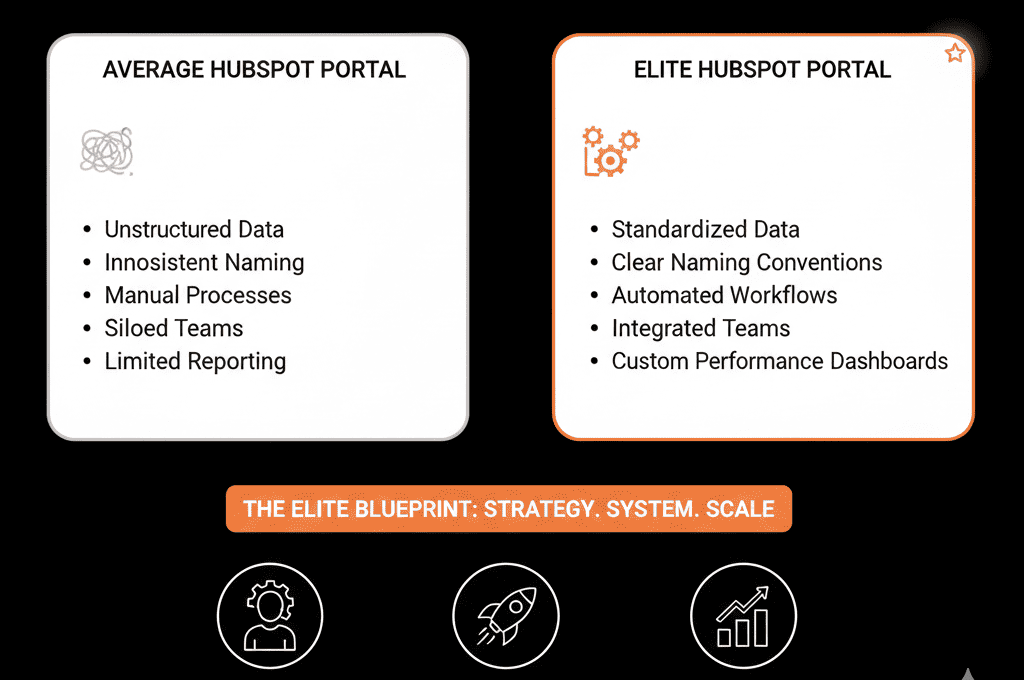
10. Want to See Where Your Portal Sits on the Elite–Average Spectrum?
You might recognize pieces of both pictures above.
Some parts of your HubSpot instance may already look elite.
Others may feel fragile, improvised, or politically sensitive.
Our team at ElanceMind specializes in turning “it mostly works” HubSpot setups into elite revenue systems:
- We run a structured HubSpot Health Check on your portal.
- We map the exact gaps between your current setup and elite patterns.
- We deliver a prioritized 90-day roadmap focused on revenue, risk, and sanity.
You do not have to guess where to start.
You just need a clear view and a realistic plan.
→ Request your free HubSpot Portal Health Check / HubSpot Audit now.
We will show you precisely what the best-run HubSpot portals are doing differently, how your instance compares, and what to tackle first.