

Agencies Sell Growth But Run on Gut Feel
Common pattern:
- You build funnels, SLAs, and dashboards for clients.
- Internally, growth is: referrals, founder network, a few inbound leads.
- Pipeline lives in spreadsheets or people’s heads.
No clear view of:
- New vs retainer vs expansion.
- Capacity vs pipeline.
- CAC and payback.
HubSpot can (and should) run your GTM like you do for clients.
Here’s the architecture we use for agencies.
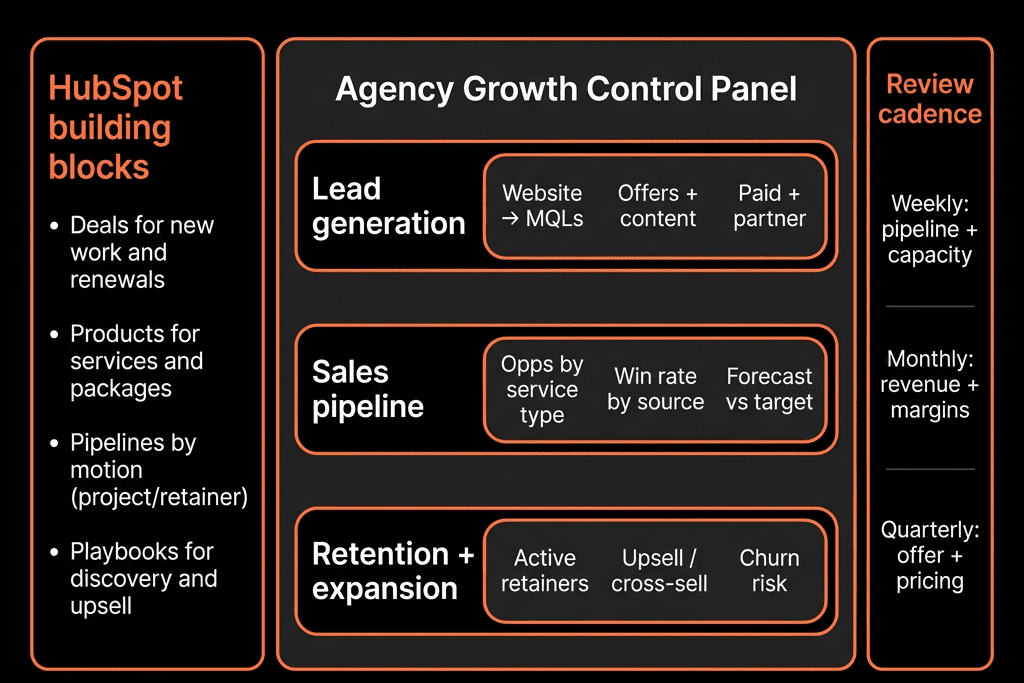
Step 1 – Treat Your Agency Like a Client in Your Own Portal
Start by defining your “offers”:
- Entry offers: audits, roadmaps, workshops.
- Core retainers: ongoing delivery (e.g., inbound, paid media, RevOps).
- Projects: implementations, migrations, builds.
- Add-ons: training, advisory, creative sprints.
Then document:
- Ideal client profile(s): verticals, size, tech stack, buying roles, triggers.
- Motions: inbound, outbound, partners, events.
This is the strategic spec you then implement in HubSpot—just like for clients.
Step 2 – Build an Agency-Specific Data Model
Companies
- Client type (Prospect, Client, Ex-client).
- ICP fit (High/Med/Low).
- Segment (SMB / Mid / Enterprise).
- Primary service focus (RevOps, Paid, Inbound, Web, etc.).
- MRR / ARR (retainer value, if applicable).
- CSM / AM owner.
Contacts
- Role (Founder, CMO, CRO, Head of Sales, Marketing Manager).
- Influence (Decision-maker / Champion / User).
- Source (Referral, Inbound content, Event, Partner, Outbound).
Deals
- Deal type (New Retainer, Project, Expansion, Renewal).
- Service line (what you’re actually selling).
- MRR (if retainer) + Project value (if one-off).
- Term length (months, where relevant).
- Close reason (for loss/win analysis).
You now have the data to see where revenue really comes from.
Step 3 – Create Separate Pipelines for New, Retainers, and Expansion
Avoid a single “Everything” pipeline.
Recommended:
- New Business pipeline – net-new logos.
- Retainer / Renewal pipeline – existing client contracts renewing.
- Expansion pipeline – additional services sold into existing clients.
Example new business stages:
- Qualified.
- Discovery & Fit.
- Solution / Proposal Drafted.
- Proposal Sent.
- Verbal Commit.
- Closed Won / Closed Lost.
Renewal pipeline:
- Renewal Identified.
- Strategy / Value Review.
- Proposal / New SOW.
- In Review.
- Renewed / Churned / Downgraded.
Expansion pipeline is similar to new business but only for existing clients.
This gives you clear visibility on new vs existing revenue.
Step 4 – Standardize Lead Intake and Qualification
Most agencies lose control at the top:
- Inquiries via website, LinkedIn, referrals… handled ad hoc.
Use HubSpot:
- Forms for:
- “Talk to sales”.
- “Request audit/blueprint”.
- Internal logging (Playbook or quick form) for:
- Referrals.
- Founder network intros.
- Partner-sourced opps.
Workflows:
- Create Company + Contact.
- Set Lifecycle stage = MQL/SQL based on fit + intent.
- Assign owner (SDR/founder/AE).
- Create task: “Qualify [Company] within 24 hours”.
Qualification fields:
- Budget range band.
- Timeline.
- Tech stack (e.g., CRM/marketing tools).
- Primary problem (lead gen, RevOps, sales, web).
You treat your leads the way you tell clients to.
Step 5 – Turn Entry Offers Into Repeatable Deal Sources
Entry offers (audits, blueprints, quick wins) are your doorways.
In HubSpot:
- Each entry offer has:
- Landing page + form.
- Associated workflow that:
- Tags Entry offer type.
- Creates a Deal in a specific pipeline stage (e.g., “Audit – New”).
- Notifies sales/founder.
Track:
- How many audits are requested.
- How many convert to retainers/projects.
- Which sources/campaigns drive them.
This creates a repeatable top-of-funnel mechanic, not just one-off “free consults”.
Step 6 – Implement a Renewal Engine for Retainers
Churn quietly kills agencies that only focus on new logos.
On each client Company:
- Store:
- Retainer start date, Retainer end/renewal date.
- Current MRR/ARR.
- Health (Red/Amber/Green).
Use workflows:
- 90/60/30 days before renewal:
- Auto-create a Renewal Deal.
- Assign to AM/CSM.
- Create tasks:
- Run value review.
- Propose next quarter/term plan.
- Adjust scope/fees as needed.
Track:
- Renewed vs Churned vs Downgraded.
- Reasons (budget, strategy shift, performance, etc.).
Now your book of business is visible and manageable inside HubSpot.
Step 7 – Use HubSpot for Expansion and “Land-and-Expand” Plays
Most agency growth is expansion:
- New channels.
- New markets.
- New services (e.g., adding RevOps to a marketing retainer).
Approach:
- On Companies: keep simple flags per service line (Has Paid, Has Inbound, Has RevOps, etc.).
- Build lists:
- Clients with high fit/potential for Service X that don’t have it yet.
- Create Expansion Deals when you:
- See performance wins you can scale.
- Identify new problems you can solve.
Use sequences and Playbooks:
- Expansion play sequences for AMs.
- Brief Playbooks for value review calls (“Where should we go next?”).
This shifts you from “upsell when someone asks” to programmatic expansion.
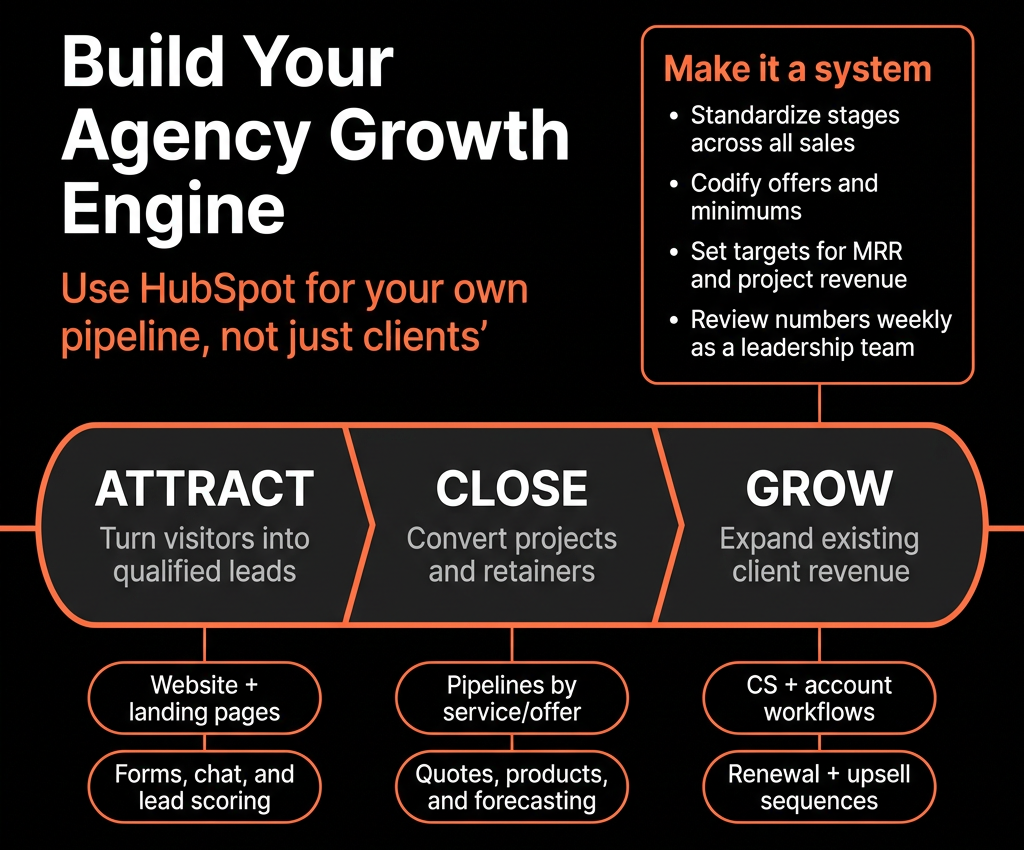
Step 8 – Build the Agency Growth Dashboard Set
Dashboards we rely on:
New Business & Pipeline
- New Deals created by segment and service line.
- New Business pipeline by stage and owner.
- Closed Won new MRR/project value vs target.
Retainers & NRR
- Active retainer MRR/ARR by segment, vertical, and service line.
- Renewal pipeline by stage and term.
- Churned and downgraded revenue with reasons.
- Simple NRR/GRR view (if data supports).
Expansion & Cross-Sell
- Expansion Deals by service line in play.
- Expansion revenue vs target.
- Penetration: % of clients using each core service.
Source & Marketing Performance
- Leads and opps by source/channel (Referrals, Content, Outbound, Events, Partners).
- Entry offers → Opps → Retainers conversion.
- Cost per opp (rough) if you track spend.
You can run leadership, sales, and CS meetings from these directly in HubSpot.
Step 9 – Align Capacity Planning With Pipeline
Agencies die from over/under-capacity.
Use HubSpot to:
- Track:
- Expected project start dates.
- Retainer start/renewal dates and MRR impact.
- Work with delivery ops (even in a separate tool) to:
- Overlay pipeline on current staff capacity.
- Identify when you can safely sell more vs when you need to slow or hire.
Even a basic “project start month” field and a simple view:
- “Projects starting next 60–90 days by team/service.”
…is far better than nothing.
Step 10 – Run Your Own GTM Rhythms From HubSpot
You tell clients to do this; do it yourself:
Weekly revenue standup from HubSpot dashboards and Forecast.
Monthly GTM review with marketing, sales, CS looking at:
- New, expansion, churn.
- Source performance.
- Funnel conversion.
Quarterly strategy review:
- NRR by segment.
- Which offers and verticals work best.
- Where to focus next quarter.
No hidden spreadsheets. HubSpot is your growth engine, not just your clients’.
Want Help Turning Your Agency’s HubSpot Into a Real Growth OS?
If your own CRM is a weaker version of what you build for clients, that’s fixable.
Through our HubSpot Implementation Blueprints, Portal Health Check, and Managed RevOps Retainer, we:
- Design an agency-specific RevOps architecture (offers, ICP, data model, pipelines).
- Implement lead, pipeline, renewal, and expansion plays in HubSpot.
- Build dashboards for founders, sales, and AM/CS teams.
- Help you turn your own portal into a live case study for prospects.
So when clients ask, “How do you run growth for yourselves?”—you can just open HubSpot and show them.