

Your Book Lives in the AMS. Your Growth Should Live in HubSpot.
Most insurance teams:
- Use an AMS for policies and accounting.
- Export renewal lists to Excel.
- Rely on producers’ memory for cross-sell.
HubSpot should sit on top as the growth layer:
- Renewals as Deals with owners, stages, and tasks.
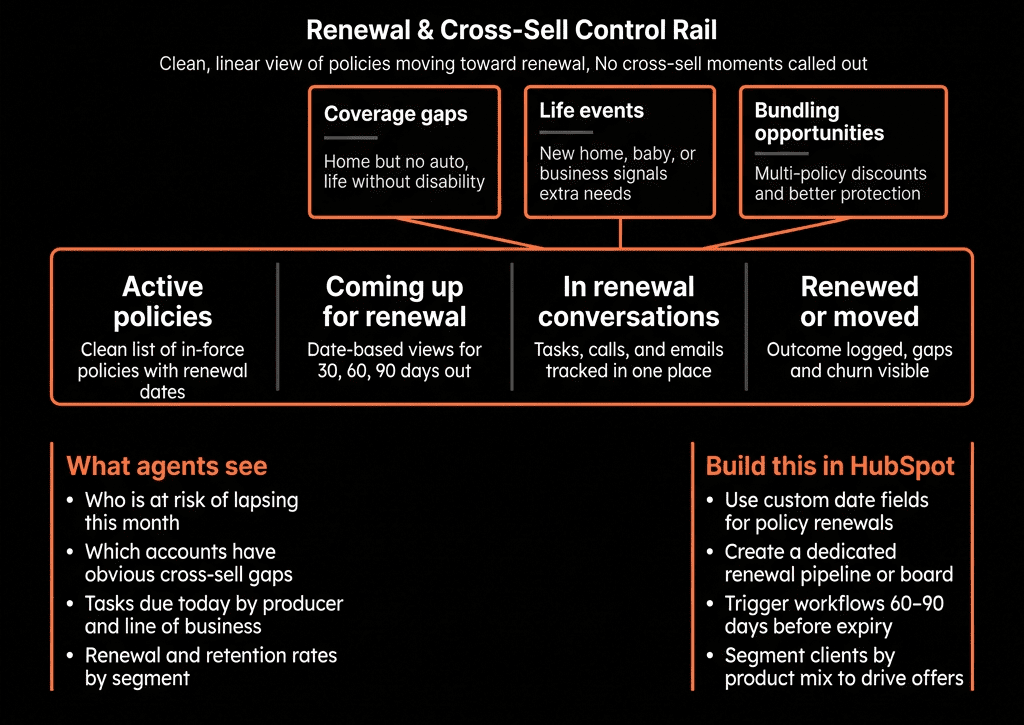
- Coverage gaps surfaced as cross-sell opportunities.
- Dashboards for retention and expansion.
Below is a practical structure.
Step 1 – Mirror the Book at Account Level in HubSpot
Use Companies to represent accounts (commercial) or Households (personal).
On Company:
- Client status (Prospect, Active, Lapsed).
- Segment (Small Commercial / Mid / Large / Personal).
- Industry (for commercial).
- Primary producer / account manager.
- Total annual premium band (optional).
Store coverage footprint with simple flags:
- Has GL, Has WC, Has Property, Has Auto, Has Umbrella, Has Cyber, etc.
Populate via:
- One-time import from AMS.
- Ongoing updates when new policies are written.
Now HubSpot knows which client has which lines.
Step 2 – Treat Renewals as Deals in a Renewal Pipeline
Create a Renewals pipeline.
Deal fields:
- Deal type = Renewal.
- Line of business (or multiple if you group).
- Current carrier.
- Current annual premium.
- Effective date, Renewal date.
- Renewal outcome (Renewed / Moved / Lapsed / Downgraded).
Stages example:
- Renewal Identified.
- Pre-renewal review.
- Marketing/Remarket.
- Quoted.
- Presented.
- Bound / Lost.
Every renewal should be a Deal associated to the Company and key Contacts.
Step 3 – Auto-Create Renewal Deals Before Effective Dates
Stop relying on spreadsheets.
On Company (or a custom Policy/Contract object), store:
- Next renewal date per line or combined.
Then:
Company-based workflow:
- Trigger: X days before Next renewal date (e.g., 120/90/60).
- If no open Renewal Deal:
- Create a Renewal Deal in the Renewals pipeline:
- Deal type = Renewal.
- Close date = renewal date.
- Amount = current annual premium.
- Owner = account’s producer/AM.
- Create tasks:
- “Run loss/coverage review”.
- “Schedule renewal strategy call”.
Result: you see a renewal pipeline by month/quarter in HubSpot.
Step 4 – Capture Risk and Expansion Potential at Review Time
Add health/expansion fields on Companies:
- Retention risk (Low/Med/High).
- Cross-sell potential (Low/Med/High).
- Interested in [LOB] flags.
Use Review/QBR Playbooks:
- Ask about:
- Satisfaction with current coverage, service, and pricing.
- Business changes (new locations, vehicles, staff, contracts).
- Awareness/interest in coverages they don’t have (Cyber, EPLI, D&O, etc.).
Map to:
- Retention risk.
- Expansion interest – Cyber/Benefits/Umbrella/etc..
- Next step and Next step date.
This turns conversations into structured data that can trigger action.
Step 5 – Turn Cross-Sell Potential Into Opportunities
Use Expansion Deals in a separate pipeline or as Deal type = Cross-sell.
For example:
- Company has GL + Property, no Cyber.
- Review finds high risk + interest.
Action:
- Create Expansion Deal:
- Deal type = Cross-sell.
- Line of business = Cyber.
- Associate to Company + primary Contact.
Now:
- Producers see cross-sell pipeline.
- Leadership can measure cross-sell revenue.
Step 6 – Build Cross-Sell Target Lists
With coverage flags in place, create lists like:
- “Commercial clients with GL + Property, no Cyber, in manufacturing or professional services.”
- “Personal lines clients with Home + Auto, no Umbrella.”
- “Group benefits clients with Medical only, no ancillary lines.”
Segment further by:
- Cross-sell potential = Med/High.
- NPS/CSAT where tracked.
These lists drive:
- Producer outreach.
- Targeted marketing campaigns.
- Sequences for education and appointment-setting.
Step 7 – Use Sequences and Tasks for Proactive Outreach
Within HubSpot:
For producers/AMs:
- Use Sequences for warm cross-sell plays (if allowed by compliance).
- Templates: educational emails, case studies, “let’s review this coverage gap” invites.
For CSRs:
- Tasks to prompt them to mention certain coverages during service calls.
Example:
- List: “GL + Property clients, no Cyber, high potential.”
- Enroll primary contacts into a short sequence:
- Email 1: Story of a loss + cyber basics.
- Email 2: Offer 15-min exposure review.
- Task: Call follow-up.
Ensure you respect consent and local regulations.
Step 8 – Build Renewal and Cross-Sell Dashboards
Renewal dashboard:
- Renewal pipeline by stage and effective month.
- Renewed vs Moved vs Lapsed premium.
- Retention rate by segment/LOB.
- Renewals with Retention risk = High.
Cross-sell dashboard:
- Cross-sell pipeline by LOB and producer.
- Cross-sell Closed Won premium by quarter.
- Coverage penetration: e.g., % of commercial accounts with Cyber, Umbrella, etc.
- Top accounts with Cross-sell potential = High and no active cross-sell deals.
Leadership can finally see:
- Where the book is at risk.
- Where growth from existing clients will come from.

Step 9 – Keep AMS and HubSpot in Sync (Lightly)
You don’t need every policy detail in HubSpot, but you do need key fields kept fresh.
From AMS to HubSpot:
- Active client list.
- For each client/line: carrier, premium band, effective/renewal dates.
- Policy status (Active/Cancelled).
To AMS from HubSpot:
- New client/contact info when deals bind.
- Notes about cross-sell opportunities (if that’s how you work).
Document:
- Which fields sync.
- Update frequency.
- Who is responsible.
So the renewal engine in HubSpot stays accurate.
Step 10 – Embed Renewals and Cross-Sell in Weekly Rhythm
Make HubSpot the place you run your book:
Weekly producer/AM meetings:
- Review “My renewals – next 60/90 days.”
- Review “My cross-sell pipeline.”
Monthly leadership:
- Renewal performance and retention.
- Cross-sell revenue vs new business.
- Coverage penetration in target segments.
Over time:
- Producers see HubSpot as “my book and my opportunities,” not admin.
- The firm shifts from chasing new business only to protecting and expanding the book deliberately.
Want Help Building a Renewal and Cross-Sell Engine in HubSpot?
If your renewals and cross-sell are currently managed via AMS exports, Outlook, and memory, HubSpot can become the growth layer on top of your core systems.
Through our HubSpot Implementation Blueprints, Portal Health Check, and Managed RevOps Retainer, we:
- Design the account/coverage model, renewal pipeline, and cross-sell structure.
- Integrate key AMS data into HubSpot safely.
- Implement workflows, lists, and dashboards for renewals and cross-sell.
- Train producers, AMs, and CSRs to run their books from HubSpot.