

HubSpot Is More Than a Marketing Tool for B2B SaaS
If you’re running RevOps for a B2B SaaS company, you’re juggling:
- Inbound demand.
- Outbound motions.
- Trials/freemium or PLG signals.
- Expansion/renewal motions.
- Board pressure for clean metrics.
Many teams still use HubSpot mainly for:
- Marketing email.
- Basic CRM.
Meanwhile:
- Product data lives elsewhere.
- Expansion and churn are tracked in spreadsheets.
- Revenue reporting is stitched together manually.
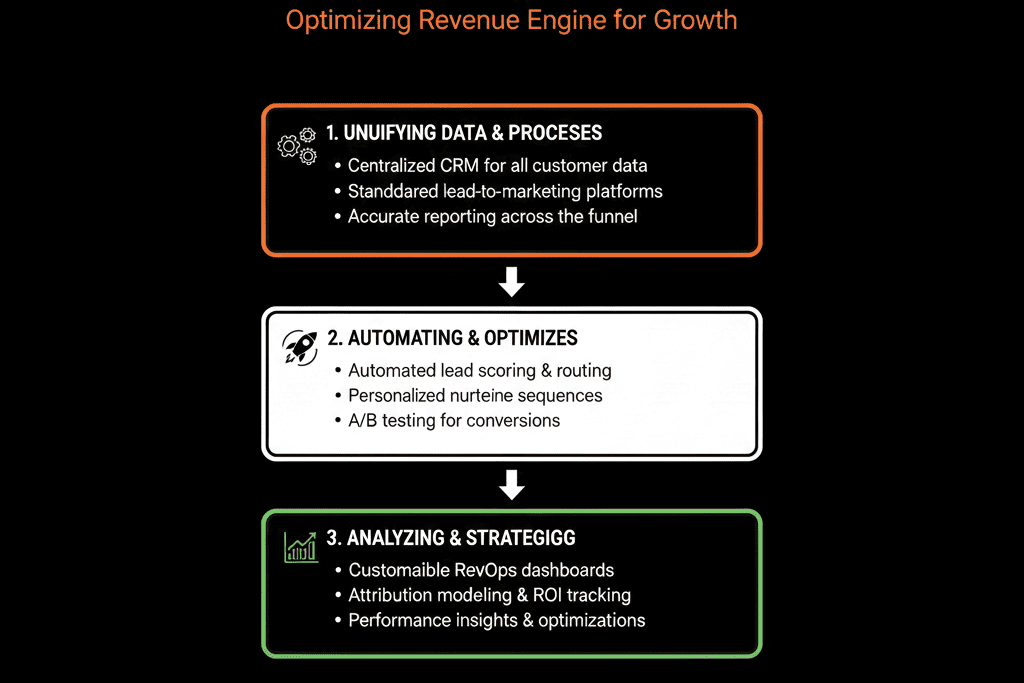
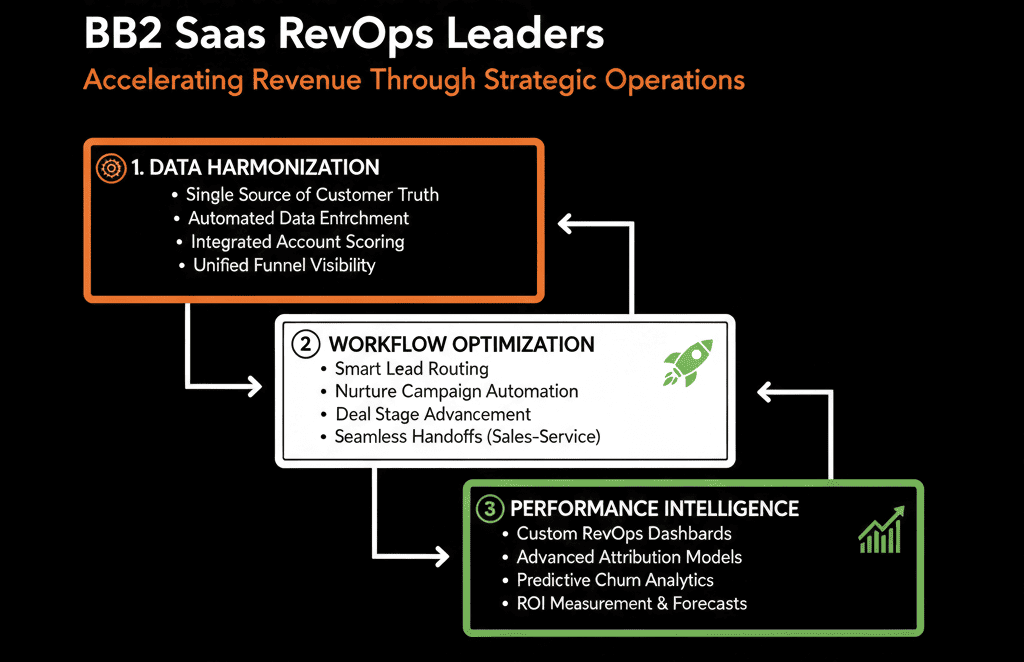
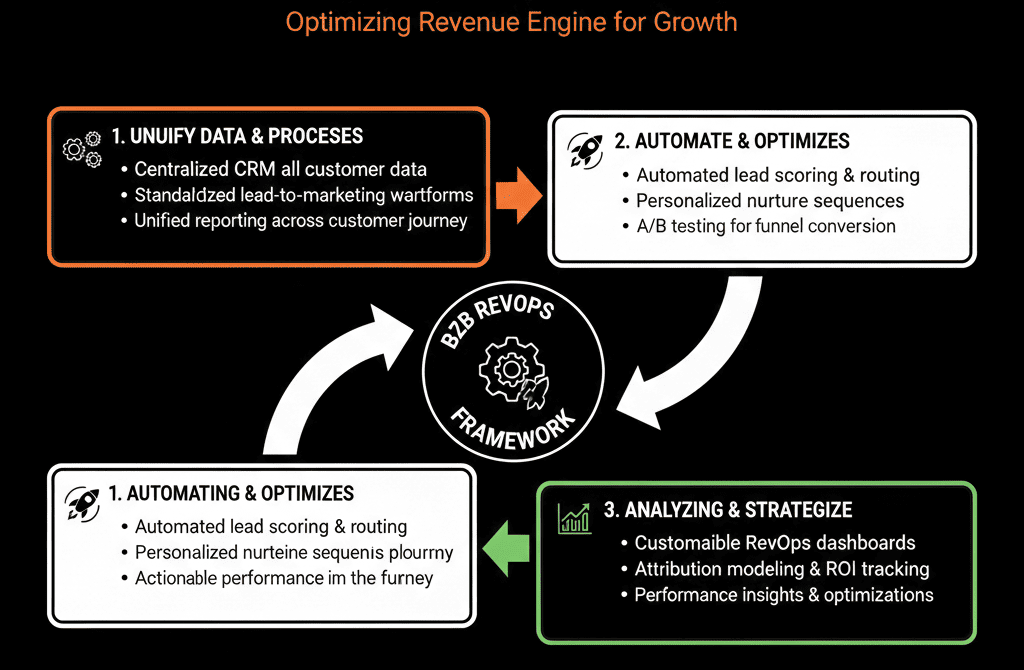
This article lays out practical HubSpot use cases B2B SaaS RevOps leaders can deploy to turn HubSpot into a true revenue operations hub.
Use Case 1 – Unified Lead Management for Inbound + Outbound + PLG
Problem
SaaS RevOps often deals with:
- Inbound (content, paid, events).
- Outbound (SDR lists, sequences).
- Product-led signals (trials, freemium, in-app actions).
Without a unified structure:
- Leads get double-worked or ignored.
- No one can see where pipeline really starts.
- Speed-to-lead becomes a guess.
How to use HubSpot
Define lifecycle for SaaS:
Subscriber → Lead → PQL/MQL → SQL → Opportunity → Customer → Expansion.
Standardize lead sources:
- Inbound (Paid, Organic, Events, Partners).
- Outbound.
- PLG/PQL (Product Qualified Leads).
Use a master intake workflow:
- Map all entry points (forms, imports, product events).
- Set Lifecycle and Lead status.
- Tag source type (Inbound/Outbound/PLG).
- Route by motion and segment.
Outcome:
One coherent lead pipeline where RevOps can see:
- Volume and conversion by motion.
- Where to shift headcount or spend.
Use Case 2 – Product Signals in HubSpot for PQL and Expansion
Problem
Product usage often lives in analytics tools only:
- Sales can’t easily see who’s active and ready to upgrade.
- CS can’t see usage context when handling tickets.
- Marketing can’t trigger targeted upsell campaigns.
How to use HubSpot
Integrate product data at a summary level:
- Avoid dumping every event.
- Bring in key signals as properties on Contacts and Companies (e.g., last login, usage tier, seats, MAU).
Define PQL criteria (example):
- Active in last 7 days.
- Hit a certain usage threshold.
- Invited X team members.
Use workflows to flag and route PQLs:
- Set a PQL flag or status.
- Create tasks for AEs when PQL conditions trigger.
- Create deals automatically if your motion requires it (e.g., Expansion pipeline).
- Enroll PQLs into tailored nurture sequences.
Outcome:
- Product-led signals become visible and actionable inside HubSpot for Sales and CS.
- PQL-based motions sit alongside classic lead-based motions.
Use Case 3 – SaaS-Focused Lead and Account Scoring
Problem
Generic lead scoring (page views, email opens) is too shallow for SaaS:
- Volume leads clog SDR queues.
- ICP fit and product interest aren’t weighted properly.
- Sales distrusts scores.
How to use HubSpot
Build a two-layer scoring model:
Fit score (Company/Contact):
- Industry, company size, region.
- Role/seniority.
- Tech stack indicators.
Behavior score (Engagement/Product):
- High-intent content.
- Key product events (summarized).
- Frequency/recency of engagement.
Use HubSpot score properties and supporting fields:
- Fit score on Companies/Contacts.
- Behavior score on Contacts.
- Supporting dropdown/select fields to keep scoring logic consistent. [web:85]
Define thresholds for action (example):
- Fit A + Behavior ≥ X → SQL or PQL → Sales.
- Fit B + Behavior ≥ Y → High-priority nurture.
- Fit C or low behavior → Marketing nurture only.
Build views and queues:
- SDRs/AEs work “Top PQLs” and “Top scored leads” from HubSpot views based on scores.
Outcome:
- Sales sees fewer, higher-quality leads.
- Marketing and product have a clear target scoring definition to optimize toward.
Use Case 4 – Renewal and Expansion Pipelines in HubSpot
Problem
Many SaaS companies:
- Track renewals and expansions in spreadsheets or CSM tools only.
- Don’t reflect them in HubSpot, or mix them with new-business deals.
- Have no unified revenue view.
How to use HubSpot
Create separate pipelines for:
- Renewals.
- Expansion/upsell (or a unified Customer Revenue pipeline).
Connect customer records:
- Use the Company object to associate all new, renewal, and expansion deals.
- Track contract value and ARR/MRR fields (as standardized properties).
Automate renewal creation:
- Use workflows to create renewal deals X days before term end.
- Assign owners (CS/AM).
- Set tasks and reminders.
Build CS/Expansion dashboards:
- Renewal pipeline health.
- Renewal forecast vs target.
- Expansion revenue by segment.
- Churn and contraction visibility.
Outcome:
- HubSpot holds full-funnel revenue, not just new business.
- RevOps can see where net retention is won or lost.
Use Case 5 – Full-Funnel Revenue Reporting for Board and Leadership
Problem
B2B SaaS boards ask:
- What’s our new vs expansion mix?
- How is pipeline coverage by segment and region?
- What’s our conversion from free → paid, trial → paid, and opp → customer?
Without HubSpot as a central RevOps engine:
- Answers come from scattered tools.
- RevOps spends days in Excel before every board deck.
How to use HubSpot
Standardize deal types and tags:
- Use Deal properties for New business vs Renewal vs Expansion, Product/plan, Region/segment.
Make HubSpot the single pipeline view:
- All material revenue-impacting deals must live in HubSpot.
- Other tools can feed signals, but pipeline stays here.
Create SaaS-specific dashboards and reports:
- New business vs expansion revenue over time.
- Pipeline by segment/product/region.
- Free/trial → paid conversion rates (if integrated).
- Win rate and cycle length by segment.
- Cohort views where possible.
Use funnel and multi-source reporting where appropriate:
- Build custom reports across multiple HubSpot data sources using the custom report builder.
- Use custom funnel reports when you need conversion rates between lifecycle stages or deal stages.
Align with finance:
- Reconcile definitions and date fields with finance.
- Document which HubSpot dashboards are board-ready.
Outcome:
- Less last-minute data wrangling.
- A consistent picture of revenue health leadership and investors can rely on.
Use Case 6 – Churn and Risk Early Warning Through HubSpot
Problem
Churn is often “noticed” too late:
- When invoices aren’t paid.
- When CS hears anecdotally that a customer is unhappy.
- When growth targets are missed.
How to use HubSpot
Bring health and risk signals into HubSpot (summarized):
- From product: low/declining usage.
- From CS: tickets, NPS/CSAT, risk flags.
- From billing: failed payments, overdue invoices.
Use workflows to flag at-risk accounts:
- Example: Health = Poor OR Usage drop OR Negative feedback → flag Company as At Risk.
- Create tasks and deals in the CS/renewal pipeline.
Build a “Churn Risk” dashboard:
- At-risk customers by segment/region.
- ARR at risk and by risk level.
- Churned customers by cause (if tracked).
Outcome:
- Churn becomes proactive, not reactive.
- RevOps has a central place to see risk, not just “feel” it.
What You Can Do in the Next 30–60 Days
If you’re a B2B SaaS RevOps leader and HubSpot currently feels underused:
- Pick 2–3 use cases above that match your biggest current gaps.
- For each, define a minimum viable implementation in HubSpot: lead management structure, PQL criteria/properties, basic renewal/expansion pipeline, one or two executive dashboards.
- Implement in phases, not all at once.
- Involve Marketing, Sales, CS, Product, and Finance in definitions.
- Use HubSpot as the shared language between them.
Want a SaaS-Specific HubSpot Health Check for Your RevOps Motion?
If HubSpot is still operating as “Marketing’s tool” in your SaaS business, you’re missing its biggest RevOps potential.
Our HubSpot Portal Health Check / HubSpot Audit for B2B SaaS can:
- Assess how well your current setup supports inbound, outbound, and PLG motions.
- Assess renewals and expansion readiness.
- Assess whether your reporting setup matches SaaS leadership/board needs.
- Identify high-impact SaaS use cases you can implement quickly.
- Deliver a 60–90 day action plan to turn HubSpot into your RevOps command center.