

If Your Data Is Dirty, Your RevOps Strategy Is Theoretical
Most RevOps conversations center on:
- Better handoffs between Marketing, Sales, and CS.
- Cleaner lead qualification.
- Stronger forecasting and reporting.
- Smarter automation and playbooks.
All of that lives in HubSpot.
And HubSpot only works as well as the data inside it.
If your data is messy:
- Routing rules misfire.
- Forecasts lie.
- Automations break in edge cases.
- Teams fall back to spreadsheets and anecdotes.
Data hygiene is not a side project for admins. It is a strategic pillar of RevOps.
In this article, we’ll unpack what “data hygiene” really means in HubSpot, why it’s critical for any RevOps program, and how to operationalize it.
Step 1 – What “Data Hygiene” Actually Means in a HubSpot Context
Data hygiene is more than “no duplicates.”
In HubSpot, it means:
Correctness
Key fields reflect reality (owner, lifecycle, stage, country, industry, ARR).
Completeness
The minimum set of fields needed for routing, segmentation, and reporting are filled.
Consistency
Values are standardized (e.g., “United States” vs “US/USA”).
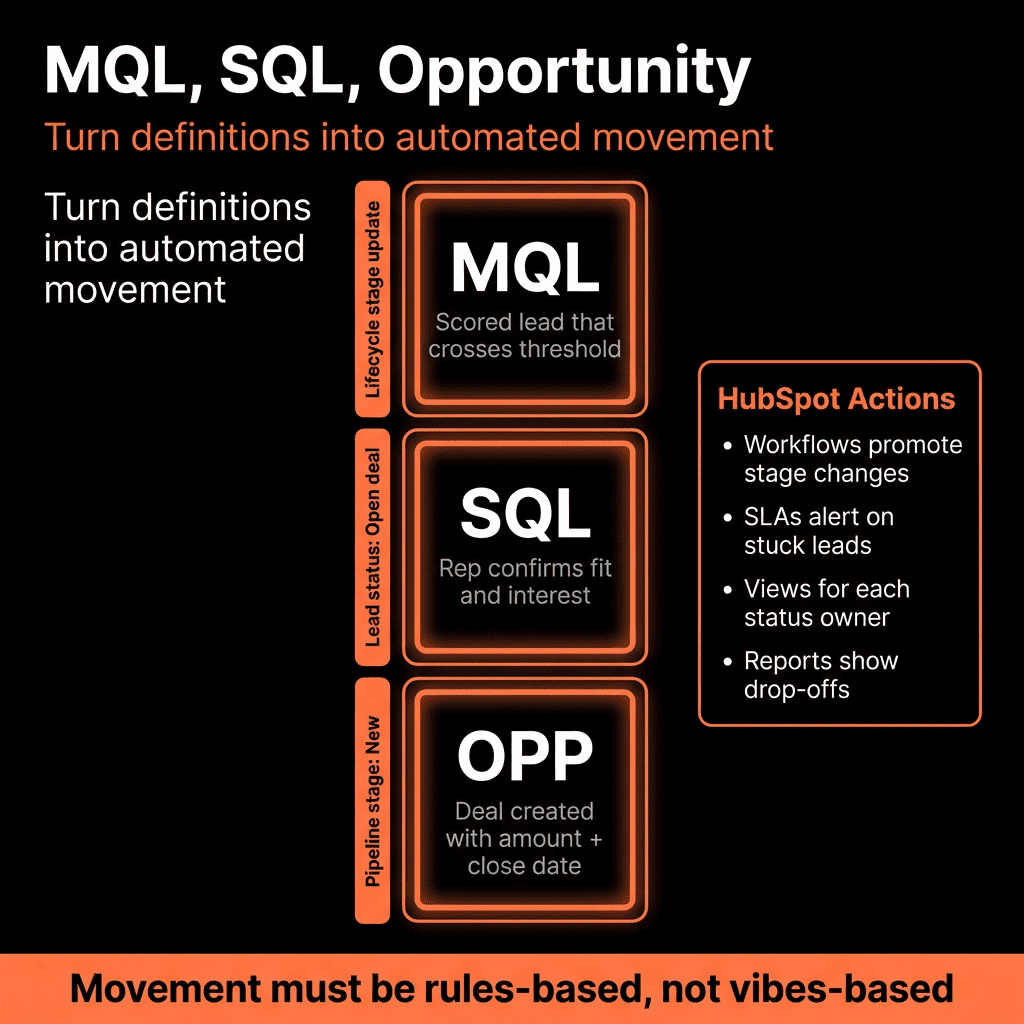
Shared definitions across teams (what is a Lead/MQL/Customer).
Coherence
Lifecycles and deal stages follow logical progressions.
Contacts, Companies, Deals, and Tickets are properly associated.
Control
New tools and workflows don’t silently pollute or overwrite critical data.
There is governance around properties and integrations.
This is the substrate on which every RevOps initiative in HubSpot depends.
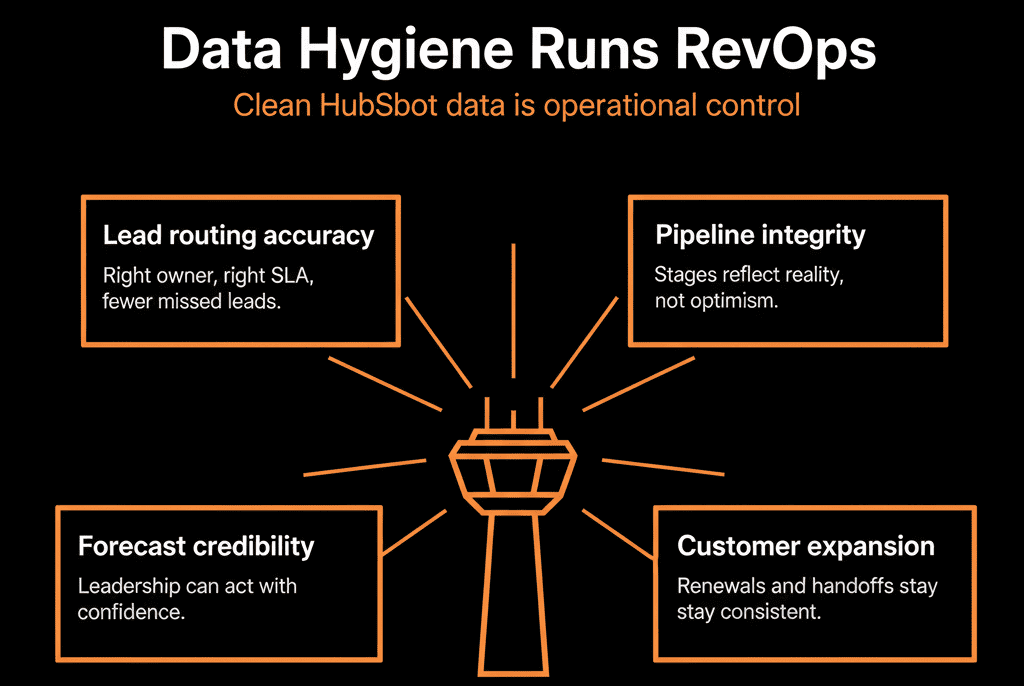
Step 2 – How Data Hygiene Underpins Core RevOps Outcomes
RevOps is about aligning and optimizing the revenue engine. Clean HubSpot data is what makes that engine measurable and controllable.
Alignment between Marketing, Sales, and CS
Shared fields and lifecycles are the language of alignment.
If lifecycle, lead source, or ICP flags are inconsistent or missing:
- Marketing and Sales argue about lead quality.
- CS lacks context at handoff.
Lead routing and speed‑to‑lead
Routing logic depends on:
- Country/region.
- Product interest.
- Channel/source.
Bad data → leads go to wrong people or nowhere → direct revenue loss.
Forecasting and pipeline management
Reliable forecasts depend on:
- Correct deal stages, amounts, and close dates.
Dirty data here → leadership can’t trust pipeline → decisions are delayed or wrong.
Attribution and ROI analysis
Knowing which channels and campaigns work relies on:
- Clean source and campaign fields.
- Consistent lifecycle and deal associations.
Messy data → you keep funding what “feels right,” not what’s proven.
Automation and playbooks
Workflows and sequences can’t reliably:
- Enrich, segment, and trigger actions on bad data.
Poor hygiene → brittle automations that break or misfire, eroding trust in the system.
CS and retention motions
Health scoring, renewal plays, and expansion triggers depend on:
- Accurate account data.
- Proper associations between companies, deals, tickets, and product usage.
In short: RevOps strategies fail if HubSpot hygiene is not treated as a first‑order concern.
Step 3 – Make Data Hygiene a Defined Pillar in Your RevOps Program
Instead of treating hygiene as “maintenance work,” define it as a RevOps workstream with:
Scope
Which objects and fields matter most (Contacts, Companies, Deals, Tickets, key custom objects).
Which metrics and processes depend on them.
Objectives
Improve data completeness for key fields to X%.
Reduce duplicates to below Y%.
Align lifecycle and stage usage across teams.
Initiatives
Health Check and clean‑up.
Validation rule design (required fields, dropdowns, stage‑based requirements).
Automated normalization and enrichment workflows.
Ownership
A named data owner or RevOps lead responsible for hygiene initiatives.
This reframes clean data as a strategic enabler, not an after‑hours chore.
Step 4 – Operationalize Data Hygiene with Processes and Cadence
Data hygiene is not a one‑off project. It needs a cadence.
Monthly
Monitor data health dashboards:
- % of records with owners and key fields filled.
- Duplicates and orphan records.
- Deals missing amounts or close dates.
Fix small issues and adjust validation rules.
Quarterly
Run a light Health Check:
- Are new properties proliferating?
- Are workflows behaving as intended?
- Are integrations introducing noise?
Triage clean‑up projects:
- Backlog of records to fix.
- Legacy fields or workflows to retire.
Annually (or when major GTM changes happen)
Revisit your data model and property list:
- Deprecate unused fields.
- Add new ones with clear definitions.
- Ensure lifecycles and stages still match reality.
This cadence keeps HubSpot aligned with the business as it evolves.
Step 5 – Use HubSpot Features to Embed Data Hygiene into Daily Work
Make hygiene part of normal workflows—not a separate activity.
Tools to use:
Property types and dropdowns
Replace free‑text with controlled lists for country, region, industry, ICP tier, etc.
Required fields at the right moments
On forms.
On record creation.
On key stage transitions (Deals, Tickets).
Workflows for normalization and enrichment
Standardize country and industry values.
Copy company details to contacts/deals.
Enrich missing firmographics from trusted sources.
Validation logic and alerts
Flag deals over a certain size with missing close dates or owners.
Prevent lifecycle regression through automatic correction.
Data health dashboards
Visible to RevOps and leadership.
Track a small set of hygiene KPIs over time.
Result: data hygiene becomes a natural byproduct of how people already use HubSpot.
Step 6 – Tie Data Hygiene Directly to Revenue Metrics
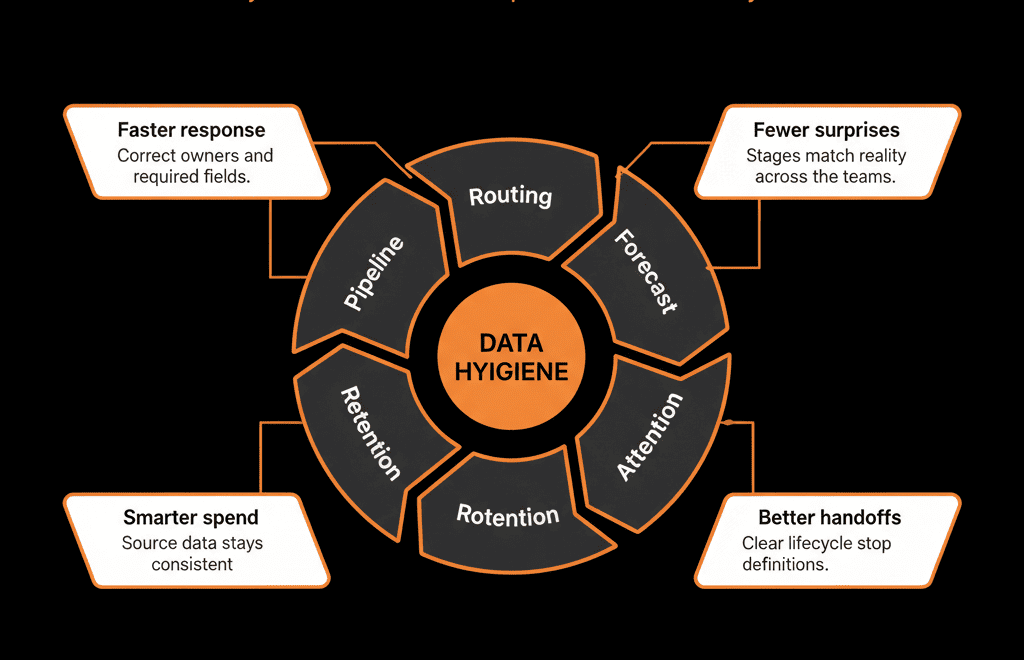
To keep hygiene strategic, always connect it back to revenue outcomes.
Examples:
Lead routing SLA improvement
Before: 60% of high‑intent leads routed correctly, 40% delayed or lost.
After hygiene work: 90%+ routed within SLA.
Impact: more opportunities and pipeline from the same volume.
Forecast accuracy
Measure forecast vs actual before and after improving deal data.
Highlight reduced variance as a result of better stage and amount hygiene.
Expansion and retention
Track uplift after cleaning and structuring customer data for CS.
Link improved health scoring and playbooks to ARR growth and churn reduction.
Present hygiene projects as:
“We did X clean‑up and validation changes → Y improvement in this metric.”
This keeps investment in hygiene defensible and ongoing.
Step 7 – Assign Clear Ownership and Governance
Without ownership, hygiene efforts fade.
Define:
Data owner / RevOps lead
Accountable for data strategy and hygiene processes.
Property governance
Rules for creating new properties:
Business justification.
Defined owner.
Added to the data dictionary.
Integration governance
Rules for connecting new tools:
What they can write to.
How conflicts with existing data are resolved.
Change management
Simple process for:
Deprecating fields.
Changing lifecycle and stage logic.
Rolling out new validation rules.
This governance doesn’t need to be heavy—but it does need to exist.
Pulling It Together: Data Hygiene as a Revenue Lever, Not a Cleanup Task
For HubSpot‑centric RevOps, data hygiene is:
- The difference between routing and forecasting that work, and ones that don’t.
- The difference between automation that helps, and automation nobody trusts.
- The foundation for meaningful attribution and lifecycle reporting.
Treat it as:
- A defined pillar of your RevOps program.
- A continuous process with cadence and metrics.
- A shared responsibility, led by RevOps, supported by HubSpot configuration.
Do this, and conversations about pipeline, efficiency, and growth stop being undermined by “…but can we trust the data?”
Want Help Making Data Hygiene a Strategic Pillar in Your HubSpot RevOps Program?
If your RevOps plans are strong on paper but undermined by messy HubSpot data, this is exactly where we can help.
Our HubSpot Portal Health Check and Migration & ROI Plan are designed to:
- Audit your current data hygiene and its impact on routing, forecasting, and reporting.
- Design a practical data governance and clean‑up strategy.
- Define hygiene KPIs and processes that become part of your RevOps operating rhythm.