

Financial Firms Don’t Just Need More Leads. They Need Cleaner Relationships.
If you run or support a financial or investment business (wealth management, advisory, PE/VC, asset management, lending, etc.), your reality is:
- High-value, trust-based relationships.
- Complex compliance and documentation requirements.
- Long sales and onboarding cycles.
- Multiple touchpoints across advisors, analysts, and operations.
Most firms:
- Use a generic CRM or Excel to track interactions.
- Have siloed email trails in advisors’ inboxes.
- Struggle to see a clear picture of prospects, clients, and AUM/pipeline.
HubSpot, set up correctly, can become a relationship and pipeline command center without fighting your compliance needs.
This article outlines high-impact HubSpot use cases for financial and investment firms.
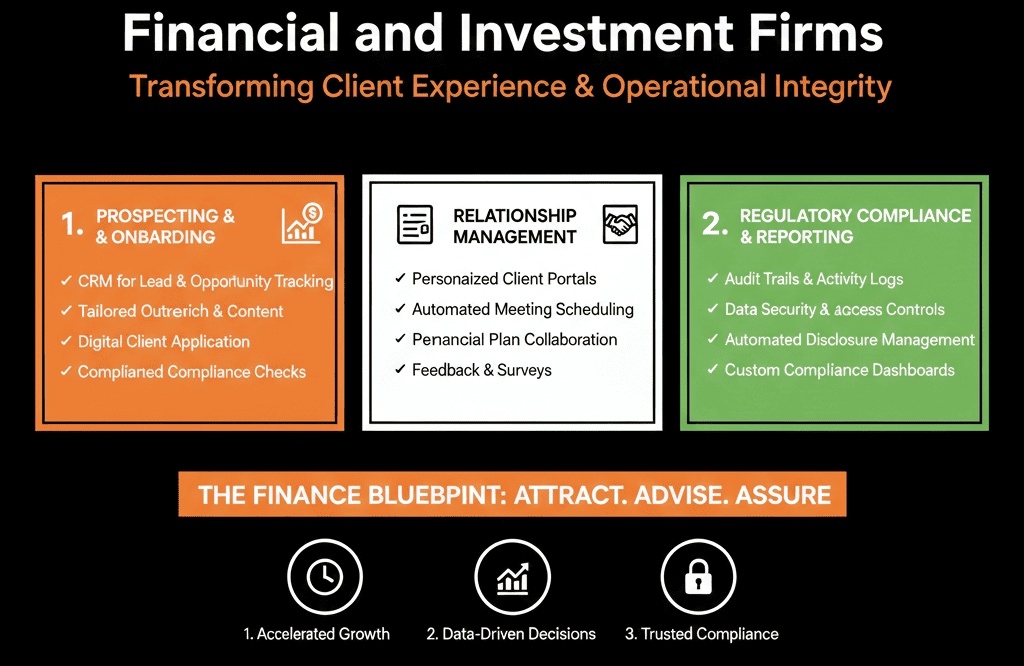
Use Case 1 – Compliance-Aware Relationship CRM
Problem
Advisors and relationship managers:
- Keep client notes in email, notepads, or personal CRMs.
- Have weak visibility into who else at the firm interacts with the same client.
- Struggle to show a clear communication history when regulators or partners ask.
How to use HubSpot
Use Contacts and Companies as your primary relationship view:
- Contacts: prospects, clients, COIs (centers of influence), intermediaries.
- Companies: corporate clients, family offices, entities, intermediaries.
Track roles and relationships:
Add fields like:
- Relationship type (Prospect, Client, COI, Partner).
- Client tier (A/B/C or Gold/Silver/Bronze).
- Advisor / RM owner.
Create these as standardized properties (dropdown/select for controlled values).
Use associations to connect:
- Households and entities.
- Advisors to their books of business.
- COIs to referred clients.
Capture key interactions in one timeline:
- Emails synced (with compliance-appropriate controls).
- Meetings and calls logged.
- Notes after significant discussions.
Ensure visibility with appropriate permissions:
- Role-based access: advisors see their books; leadership and compliance have broader visibility.
- Use access controls to limit sensitive assets and reduce accidental exposure.
- Audit-friendly: activity trails and notes stored centrally.
Outcome:
- A clear, shareable view of each relationship.
- Stronger internal collaboration and compliance posture.
Use Case 2 – Referral and COI Tracking That Ties to Revenue
Problem
Many financial firms grow via:
- Referrals from existing clients.
- COIs (CPAs, attorneys, consultants).
- Introductions from banks or other institutions.
But the source of business often isn’t tracked rigorously, so:
- It’s hard to know which relationships drive the most AUM or fees.
- Rewarding and nurturing the right partners is guesswork.
How to use HubSpot
Standardize referral source fields:
- Source type (Referral – Client, Referral – COI, Direct, Event, Online).
- Referring contact or Referring company associations.
Enforce capture at opportunity creation:
- Require the advisor to select who referred this opportunity and how it came in (controlled dropdown values).
Associate revenue with referrals:
- On Deals (or custom “Mandate/Investment” objects), track revenue, AUM, or fee amounts and referred-by fields.
Report on referral performance:
- Pipeline and closed revenue by referral type.
- Pipeline and closed revenue by specific COIs or key clients.
Outcome:
- Clear view of who truly drives growth.
- Data to support comp, recognition, and deeper partnership efforts.
Use Case 3 – New Mandate / Client Onboarding Pipelines
Problem
Winning a client is only half the battle:
- KYC/AML.
- Documentation and signatures.
- Account opening, funding, and first investment.
- Internal risk and compliance approvals.
If tracked in email and spreadsheets:
- Steps get missed.
- Onboarding times stretch.
- Client experience suffers.
How to use HubSpot
Create a dedicated onboarding pipeline (Deals or Tickets, depending on your operating model).
Example stages:
- Agreement Signed
- KYC/AML In Progress
- Account Opening / Custodian Setup
- Funding / Transfer In
- First Allocation / Investment
- Fully Onboarded
Define tasks and owners per stage:
- Compliance, operations, and advisors assigned tasks at each step.
- Due dates tied to SLA expectations.
Use workflows for reminders and escalations:
- If a stage is stuck for too long, notify ops leads and advisors.
Track onboarding cycle times and bottlenecks:
- Time in each stage.
- Time from Signed → Fully Onboarded.
- Variances by client type or channel.
Outcome:
- Predictable, transparent onboarding process.
- A better client experience and clearer view of internal constraints.
Use Case 4 – Long-Cycle Prospect Nurturing for HNW and Institutional Clients
Problem
High-net-worth and institutional prospects:
- Take months or years to move from first touch to mandate.
- Need ongoing education, trust-building, and multiple meetings.
- May go quiet and then re-emerge.
If nurturing is ad hoc:
- Some high-potential prospects are forgotten.
- Advisors only focus on active deals.
- Marketing and sales aren’t aligned.
How to use HubSpot
Segment by profile and interest:
- HNW individual, family office, institutional, corporate treasury, etc.
- Interest in specific strategies, asset classes, or services.
Build nurture programs:
- Market and investment insights.
- CIO letters and research pieces.
- Educational webinars/events.
Use workflows and scoring:
- Track engagement with key content (research, strategies, events).
- Score prospects by fit (profile, AUM potential) and engagement (opens, clicks, meetings).
Alert advisors when engagement spikes:
When a prospect:
- Downloads a key whitepaper.
- Attends a specific webinar.
- Re-engages after a quiet period.
Outcome:
- Structured, compliant-friendly touch patterns.
- Advisors spend time with prospects showing real interest.
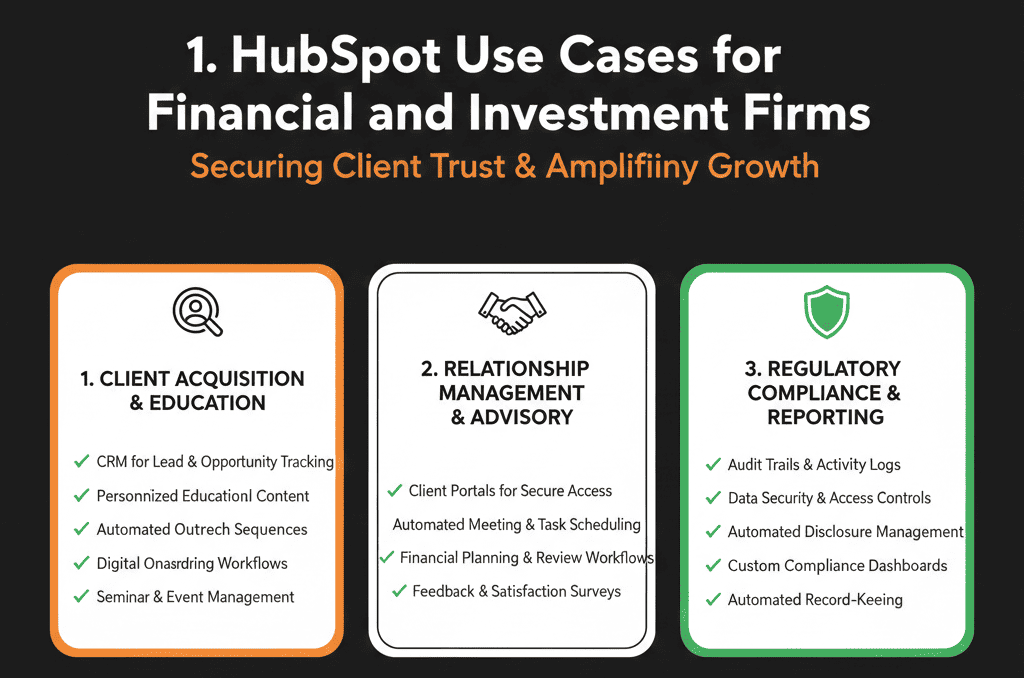
Use Case 5 – Visibility of Pipeline and AUM Growth by Channel and Segment
Problem
Leadership and partners want:
- Pipeline of new mandates and accounts.
- Growth in AUM and fees by channel, segment, and strategy/product.
Without a central view:
- Forecasting is weak.
- Tracking marketing and distribution ROI is guesswork.
How to use HubSpot
Standardize deal/mandate fields:
- Client segment (HNW, UHNW, Institutional, etc.).
- Channel (Direct, Referral, Platform, RIA, etc.).
- Product/strategy (Equity, Fixed Income, Alternatives, etc.).
- Expected AUM / mandate size.
- Fee model (AUM-based, Retainer, Performance, etc.).
Create these as consistent properties and control access where needed (view/edit permissions by role/team).
Ensure all real opportunities are in HubSpot:
- No “shadow pipelines” in spreadsheets.
- Subjective items kept out or tagged differently (e.g., Early-Stage).
Build leadership dashboards:
- Pipeline AUM and expected fees by segment, channel, and product/strategy.
- Closed-won AUM and fees by period.
- Win rates and cycle times by segment.
Align with finance and portfolio systems:
- Reconcile booked vs actual funded AUM.
- Reconcile fee actuals vs projections.
Outcome:
- A reliable source of truth for growth discussions.
- Data to inform resource allocation and distribution strategy.
Use Case 6 – Campaigns and Events That Tie Back to Real Revenue
Problem
Marketing runs:
- Investor days.
- Webinars.
- Content and thought leadership campaigns.
But:
- It’s hard to prove which efforts lead to real mandates and capital.
- Marketing and distribution argue about impact.
How to use HubSpot
Use campaigns to track initiatives:
- Each event, webinar, or content series becomes a HubSpot campaign.
- Associate emails, landing pages, forms, lists, and influenced deals.
Track influenced pipeline and revenue:
- Engaged contacts per campaign.
- Opportunities created/influenced (count and value).
- Closed-won AUM/fees by campaign.
Report by strategy and audience:
- Which campaigns are most effective for HNW vs Institutional.
- Which campaigns perform best for specific product lines.
Outcome:
- Clearer view of which marketing/distro activities move the needle.
- Better decision-making on where to invest limited time and budget.
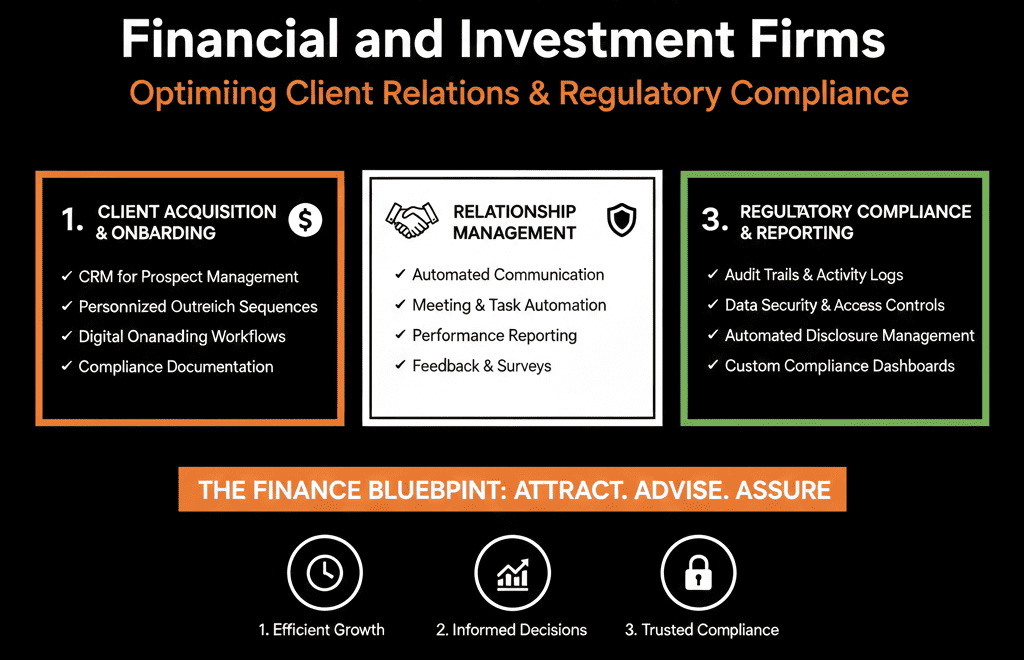
What You Can Do in the Next 30–60 Days
If you’re in financial services or investment and want HubSpot to support real growth and compliance:
- Start with relationship clarity: clean up Contacts and Companies with relationship type, segment, and owner/advisor fields.
- Implement one of these use cases first: referral tracking tied to revenue, a simple onboarding pipeline, or a basic segment/channel pipeline/AUM dashboard.
- Align definitions with compliance, finance, and distribution.
- Use early wins to show advisors/partners why HubSpot matters and justify deeper architecture/reporting improvements.
Want a Financial-Services–Focused HubSpot Health Check?
Financial and investment firms operate under different constraints than typical B2B SaaS or eCommerce:
- Regulation, documentation, and risk management.
- Relationship-heavy motions.
- Complex product and fee structures.
Our HubSpot Portal Health Check / HubSpot Audit can be specialized for your world:
- Assess whether HubSpot supports your real relationship and mandate cycle.
- Identify high-impact use cases like the ones above to implement first.
- Provide a 60–90 day roadmap tailored to financial or investment workflows.