

Most “Alignment” Problems Are Really System Problems
When Marketing, Sales, and CS are misaligned, you’ll hear:
- “We don’t agree on what a good lead is.”
- “Sales never updates stages.”
- “CS doesn’t see what was promised in the sales cycle.”
The default response is usually:
- Another meeting.
- Another spreadsheet.
- Another “alignment workshop.”
Those help for a week. Then the system drags behavior back to the old normal.
We’ve found that lasting alignment happens when you treat HubSpot as your RevOps operating system and design it deliberately.
In this article, we’ll share the HubSpot RevOps framework we use to align Marketing, Sales, and CS—what we look at and how we implement it.
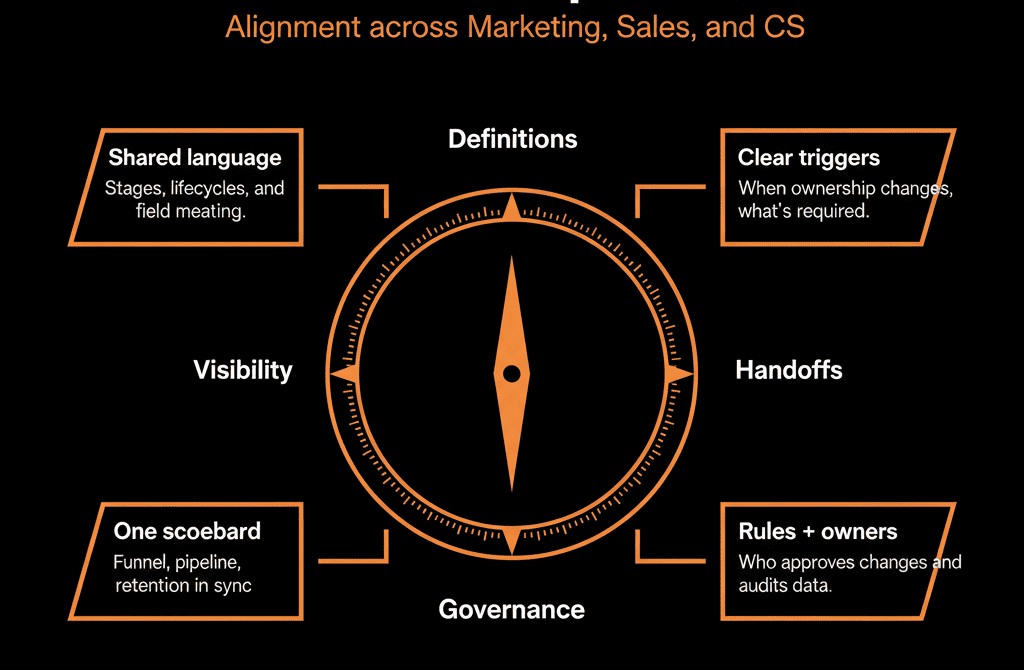
Framework Overview: Five Pillars
Our HubSpot RevOps framework has five pillars:
- Data Model & Hygiene – What exists in HubSpot and how clean/trustworthy it is.
- Process & Handoffs – How work moves between Marketing, Sales, and CS.
- Automation & Playbooks – How HubSpot orchestrates actions and removes manual work.
- Integrations & Signals – How product, billing, and support data flow into HubSpot.
- Reporting & Governance – How teams see performance and keep the system from drifting.
We apply these pillars in a consistent way across audits, migrations, and RevOps engagements.
Pillar 1 – Data Model & Hygiene
Goal: One shared source of truth that supports all three teams.
What we do:
Audit existing objects and properties
- Contacts, Companies, Deals, Tickets, and any custom objects.
- Identify duplicate or conflicting fields (e.g., multiple industries, segments).
Define a clean data model
- Contacts: people, roles, lifecycle.
- Companies: accounts, segments, ICP tiers, territory.
- Deals: opportunities with standard pipelines and stages.
- Tickets/CS objects: post‑sale work tied back to accounts.
Standardize and clean
- Normalize key fields (country, industry, lifecycle, stages).
- Set property types and dropdowns to avoid future chaos.
Implement guardrails
- Required fields at key moments (forms, stages).
- Workflows and validation rules that keep core fields consistent.
Impact:
- Marketing, Sales, and CS talk about the same customer in the same way.
- Routing, scoring, and reporting can rely on stable fields.
Pillar 2 – Process & Handoffs
Goal: Make cross‑team handoffs explicit, trackable, and reliable inside HubSpot.
What we do:
Map the journey
From anonymous → Lead → MQL → SQL/Opportunity → Customer → Onboarding → Renewal/Expansion.
Define responsibilities and required data at each stage
- Marketing: what’s needed before handing to Sales (fit + intent).
- Sales: what’s needed before passing to CS (scope, expectations, stakeholders).
- CS: what’s needed to signal expansion or churn risk back to Sales.
Encode handoffs into HubSpot
- Lifecycle stage transitions tied to real criteria.
- Deal and ticket creation with required handoff properties.
- Clear owner fields and team assignments.
Align on definitions
MQL, SQL, Opportunity, Customer, At‑Risk, Churned—documented and agreed.
Impact:
- Handoffs stop relying on tribal knowledge and become part of the system.
- Gaps in the journey become visible and fixable.
Pillar 3 – Automation & Playbooks
Goal: Use HubSpot to orchestrate revenue work, not just send emails.
What we do:
Identify manual, error‑prone steps
- Lead assignment.
- Stage updates.
- Task creation and follow‑up reminders.
- Onboarding step tracking.
Build automation where it adds clarity
Workflows for:
- Routing and assignment.
- Lifecycle updates when deals move.
- SLA enforcement and escalation (leads and tickets).
Sequences and playbooks for:
- Lead outreach.
- Opportunity follow‑up.
- Renewal and expansion plays.
Protect against automation chaos
- Keep rule sets simple and documented.
- Avoid overlapping workflows that fight each other.
- Use naming conventions and descriptions (e.g., REVOPS – Routing – Inbound leads).
Impact:
- Less manual “ops” work for reps and CS.
- More consistent and timely follow‑up.
- A system you can improve over time, not a web of mystery automations.
Pillar 4 – Integrations & Signals
Goal: Give GTM teams the right context from other systems without polluting HubSpot.
What we do:
Map core external systems
- Product/app (usage).
- Billing/finance.
- Support tools (if not using Service Hub).
- Data enrichment providers.
Define integration responsibilities
- What data flows from each system into HubSpot (and why).
- Which system is source of truth for each key field (ARR, plan, status, owner, lifecycle).
Implement “signal” properties and events
- Product: Active user?, Usage score, Key feature adopted.
- Billing: MRR, Plan, Next renewal date, Overdue?.
- Support: Open tickets, Last ticket date, CSAT/NPS.
Wire signals into workflows and views
- Trigger alerts or plays based on usage, billing, or support changes.
- Give Sales and CS prioritized lists based on real‑time signals.
Impact:
- Accounts are worked based on what’s actually happening, not guesses.
- Expansion and churn‑prevention efforts can be proactive and data‑driven.
Pillar 5 – Reporting & Governance
Goal: Give every team shared, trusted views—and keep HubSpot from drifting.
What we do:
Create role‑specific dashboards on a shared data foundation
- Executive: pipeline, forecast, new/expansion/churned revenue.
- Marketing: funnel, channel performance, lead quality.
- Sales: deal progress, win rates, activity vs outcomes.
- CS: health, retention, support volume, NRR.
Standardize definitions and KPIs
- Make sure each metric is defined in terms of HubSpot fields and logic.
- Document in a data dictionary.
Set up governance
- Property creation rules.
- Workflow and integration change management.
- Regular data health and process reviews.
Run a cadence
- Monthly: review dashboards and data quality.
- Quarterly: adjust lifecycles, stages, and workflows if the business has changed.
Impact:
- Meetings focus on decisions, not arguing whose numbers are right.
- HubSpot stays aligned with the business as it grows and evolves.
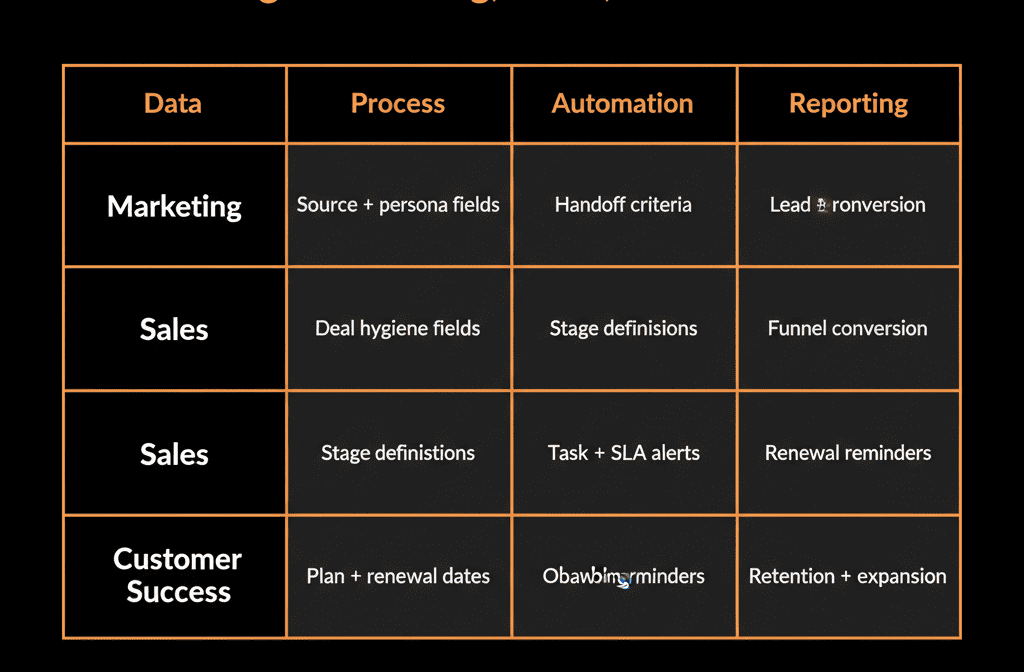
How We Apply This Framework in Practice (Simplified)
When we engage on HubSpot RevOps work, we typically:
Run a 20‑Point Health Check
- Evaluate your current portal against the five pillars.
- Identify red/yellow/green areas.
Build a RevOps‑first HubSpot blueprint
- Data model, lifecycles, and pipelines.
- Key properties and integrations.
- Automation and reporting priorities.
Sequence a 60–90 day roadmap
Phase 1:
- Stabilize routing, pipeline, and core reporting.
Phase 2:
- Improve automation, segment‑level plays, and CS visibility.
Phase 3:
- Deeper integrations, advanced analytics, and ongoing governance.
Embed governance and handoff habits
- Training and enablement for Marketing, Sales, and CS.
- Ownership of data, workflows, and integrations.
The framework stays the same—your implementation is tailored to your motion and scale.
Pulling It Together: HubSpot as the Shared RevOps Operating System
When you apply this framework, HubSpot stops being a marketing platform and becomes:
- The shared language for your customer lifecycle.
- The system of record for revenue data.
- The orchestrator of GTM work across teams.
- The analytics layer that drives strategy and optimization.
You align Marketing, Sales, and CS not by more meetings—but by a system that:
- Enforces shared definitions.
- Makes handoffs explicit.
- Surfaces the right signals.
- Keeps data healthy.
Want This Framework Applied to Your HubSpot Portal?
If you want HubSpot to truly align Marketing, Sales, and CS—rather than live as a marketing silo—this is exactly where we can help.
Our HubSpot Portal Health Check and Migration & ROI Plan are built on this framework. We:
- Assess your portal across the five pillars.
- Deliver a RevOps‑ready blueprint for data, process, automation, integrations, and reporting.
- Provide a practical 60–90 day execution plan to close gaps.