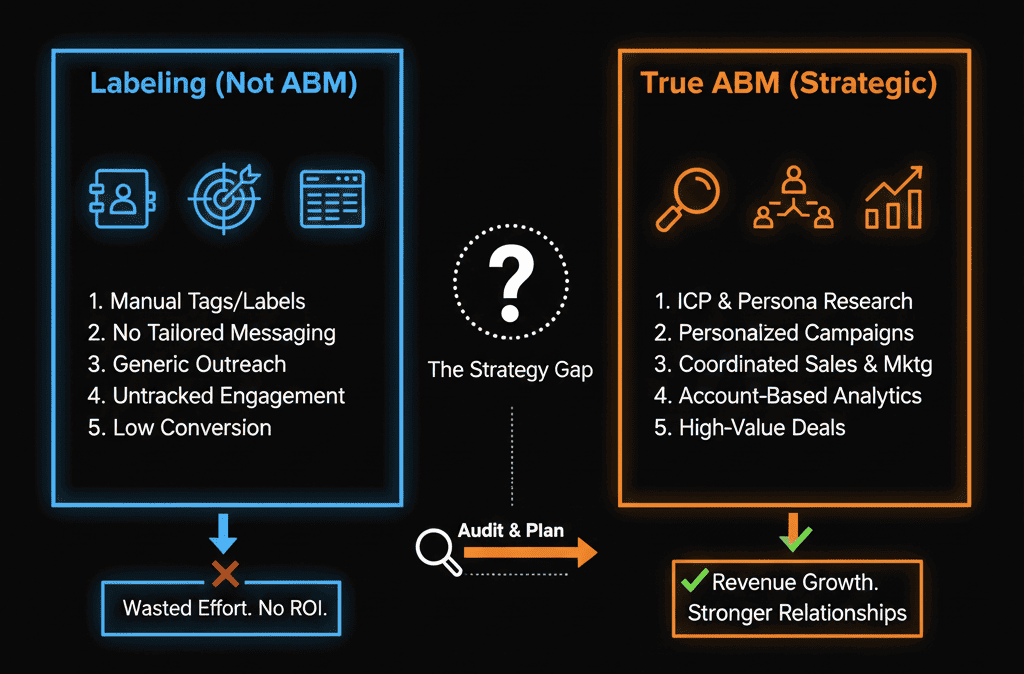


Being the “HubSpot Person” Is Not the Ceiling
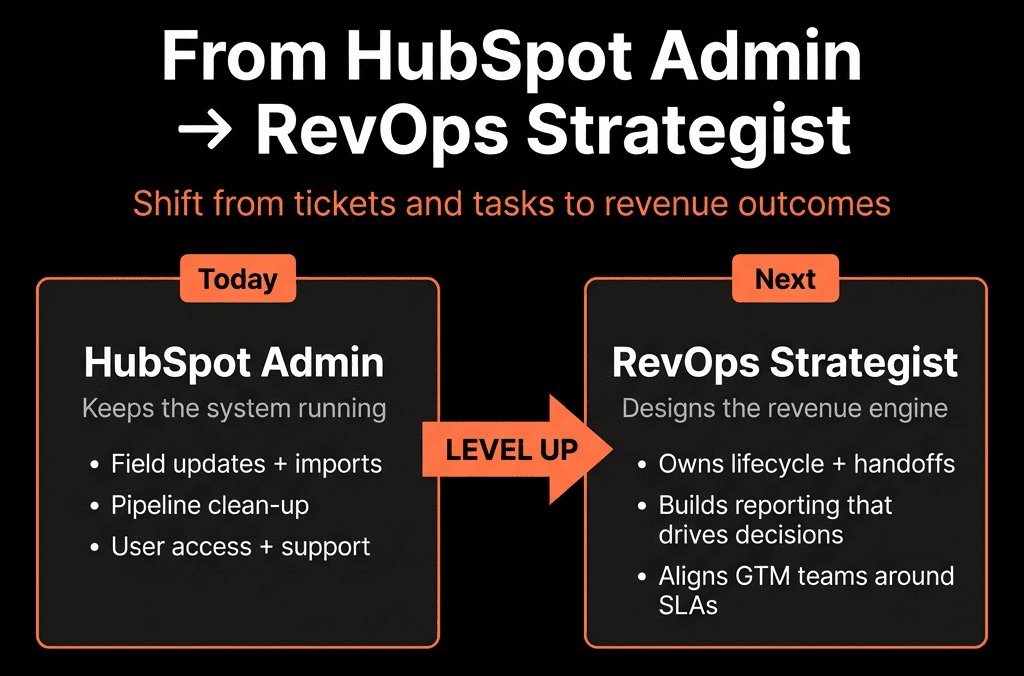
HubSpot admins get pulled into:
- “Can you add this field?”
- “Can you build this workflow?”
- “Can you fix this list/report?”
Valuable—but reactive.
If you stay there, you become a ticket-taker.
A HubSpot RevOps Strategist:
- Starts from revenue questions.
- Designs data models, funnels, and processes.
- Uses HubSpot as the operating system for GTM.
The same tool. Different posture and scope.
Below is a practical path to make that shift.
Step 1 – Change the Question You Start With
HubSpot admin mindset:
- “What do you need me to build?”
- “Which workflow/list/report should I change?”
RevOps strategist mindset:
- “What revenue problem are we trying to solve?”
- “How will we know this change worked?”
Practically:
When you get a request, always ask:
- What decision will this enable?
- What behavior are we trying to change?
- How will we measure success?
You’ll start redesigning processes, not just objects.
Step 2 – Own the Revenue Data Model, Not Just the Property List
Admins create fields.
Strategists own the data model.
Start documenting:
- Which objects you use and why (Contacts, Companies, Deals, Tickets, custom objects).
- The “spine” of key properties on each:
- ICP & segment (industry, size, region).
- Motion (deal type, pipeline).
- Funnel (lifecycle, lead status).
- Revenue (amount, MRR/ARR, product).
Then:
Create a simple data dictionary:
- Property name.
- What it means.
- Who uses it.
- Who can change it.
Bring this to conversations with leadership. That’s strategy, not admin.
Step 3 – Learn to Map GTM Motions Into HubSpot
Instead of “configure features”, think in motions:
- Inbound high-intent → SDR/AE routing and SLAs.
- Outbound prospecting → sequences, targeting, account ownership.
- New business pipeline → stages, fields, forecast.
- Renewals/expansion → dedicated pipelines, CSM workflows.
- Churn/re-activation → health scores, alerts, save plays.
For each motion, answer:
- What’s the trigger?
- Who owns each step?
- What HubSpot object and fields represent it?
- What automation supports it?
- What report inspects it?
Write these as RevOps play cards. That’s architect-level work.
Step 4 – Move From One-Off Reports to a Reporting Spine
Admins build ad hoc reports on request.
Strategists design a reporting stack that runs the business.
Start with:
- Executive revenue overview (new/renewal/expansion vs target).
- Funnel (Lead → MQL → SQL/Opportunity → Customer).
- Pipeline & forecast.
- Source/channel & segment performance.
- Activity quality & SLAs.
- Retention & NRR (if relevant).
Position it as:
- “If we had to delete every other report and keep 10–12, these would be it.”
Then run key meetings (weekly revenue, monthly GTM) from those dashboards.
Step 5 – Treat Workflows as RevOps “Plays”, Not Just Automations
Admins see workflows as tasks to complete.
Strategists see them as plays with revenue impact.
Group what you have into themes:
- Routing & ownership.
- Lifecycle & MQL/SQL rules.
- SLAs (speed-to-lead, follow-ups).
- Pipeline hygiene (stalled deals, next steps).
- Renewals & risk alerts.
- Data hygiene.
For each group, define:
- The business goal.
- The entry/exit criteria.
- The reports that prove it’s working.
Then you can say to leadership:
- “Here are the 8 automation plays currently running your funnel. Here’s what they’re doing and how they perform.”
Step 6 – Step Into Facilitation Between Marketing, Sales, and CS
Admins wait for requirements.
Strategists pull requirements via alignment conversations.
Concrete moves:
Run or co-run a funnel definition session:
- Agree MQL, SQL, Opportunity, Customer definitions.
- Map them to lifecycle, lead status, and deals.
Run or co-run a pipeline design session:
- Stage names by buyer commitment.
- Entry/exit criteria.
- Required fields.
Run or co-run a reporting needs session:
- Ask leaders, “What questions do you need to answer weekly/monthly/quarterly?”
- Map them to HubSpot capabilities.
You become the translator between GTM strategy and system design.
Step 7 – Start Talking in Revenue Terms, Not Feature Terms
When you propose a change, phrase it as:
- “This will increase MQL→SQL conversion by making routing and SLAs visible.”
- “This will improve forecast accuracy by enforcing real commit criteria.”
- “This will reduce churn risk by surfacing health + renewal pipeline by segment.”
Avoid:
- “This adds a workflow for…”
- “This report shows…” without tying it to a decision.
Even simple changes sound more strategic when linked to:
- Conversion.
- Win rate.
- Cycle time.
- NRR/GRR.
- CAC/efficiency.
Step 8 – Build a 90-Day RevOps Roadmap, Not a Ticket Queue
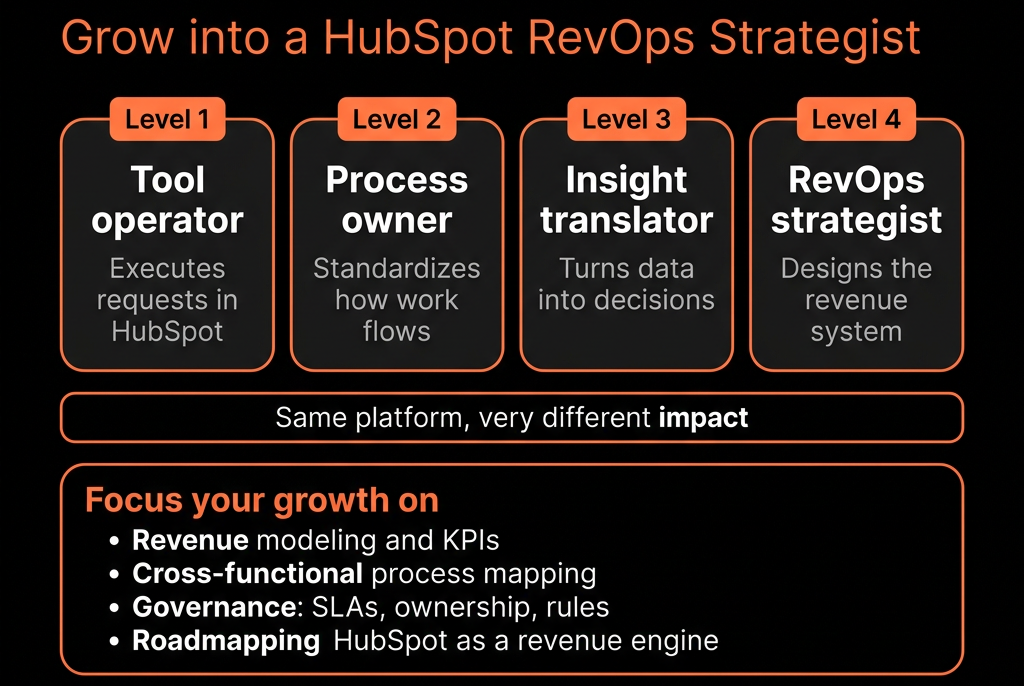
Admins work off Jira/Asana queues with isolated asks.
Strategists maintain a prioritized roadmap.
Structure it in 3 streams:
Foundations
- Data cleanup.
- Lifecycle & pipelines.
- Core properties and ownership.
Plays & automation
- Lead routing and SLAs.
- SDR→AE handoff.
- Renewal engine, etc.
Reporting & leadership
- Revenue Command Center.
- Segment/region health.
- Funnel & attribution.
For each item:
- Define impact, effort, and dependencies.
- Get buy-in from GTM leadership.
Now you’re driving the agenda, not just reacting to it.
Step 9 – Use Experiments and Before/After Metrics
Strategists think in experiments, not permanent config.
For each meaningful change:
Define baseline metrics:
- E.g., MQL→SQL rate, speed-to-lead, win rate in a stage, NRR for a segment.
Implement change in one slice:
- One region, one team, one segment.
Measure 4–8 weeks later:
- Did key metrics improve? By how much?
Examples:
- After refining routing + SLAs, MQL→SQL improved from 22% to 31%.
- After new pipeline + Playbooks, win rates in defined stages rose by 5 points.
This is when leadership starts to see you as a revenue optimizer, not just a system owner.
Step 10 – Make Your Work Visible to Leadership
Don’t assume people see the impact.
Cadence:
Monthly/quarterly RevOps update to GTM leadership:
- What we changed (in HubSpot).
- Which RevOps plays are live.
- Before/after metrics.
- Next 2–3 biggest bets.
Use screenshots of dashboards, plus 2–3 bullet insights, not config screenshots.
Over time, your brand shifts from:
- “The person who knows where everything is in HubSpot”
- to
- “The person who knows how our revenue system works and how to improve it.”
How We Help Teams Make This Leap
If you (or someone on your team) is stuck in the “HubSpot admin” box, we can accelerate the shift.
Through our HubSpot Implementation Blueprints, Portal Health Check, and Managed RevOps Retainer, we:
- Audit your current HubSpot setup and identify quick wins with real revenue impact.
- Design a RevOps architecture (data model, funnels, pipelines, automation, reporting).
- Co-build the first set of plays and dashboards with you.
- Coach you on how to position and present this as strategic RevOps work internally.
So you become the architect of a revenue system, not just the caretaker of a tool.