

Insurance Distribution Is Relationships + Timing + Process
If you run or support an insurance distribution business (broker network, MGA, wholesaler, agency group), your world includes:
- Producers and sub-agents with their own books.
- Carriers and MGAs you place business with.
- Policies with complex terms, renewals, and endorsements.
- Heavy reliance on referrals and long-term relationships.
Most networks and agencies:
- Have a legacy AMS or policy system.
- Use spreadsheets or email for producer management.
- Struggle to see pipeline, renewal risk, and cross-sell opportunities in one place.
HubSpot won’t replace your policy admin or AMS, but it can be your commercial and relationship engine if used correctly.
This article outlines practical HubSpot use cases for insurance distribution and broker networks.
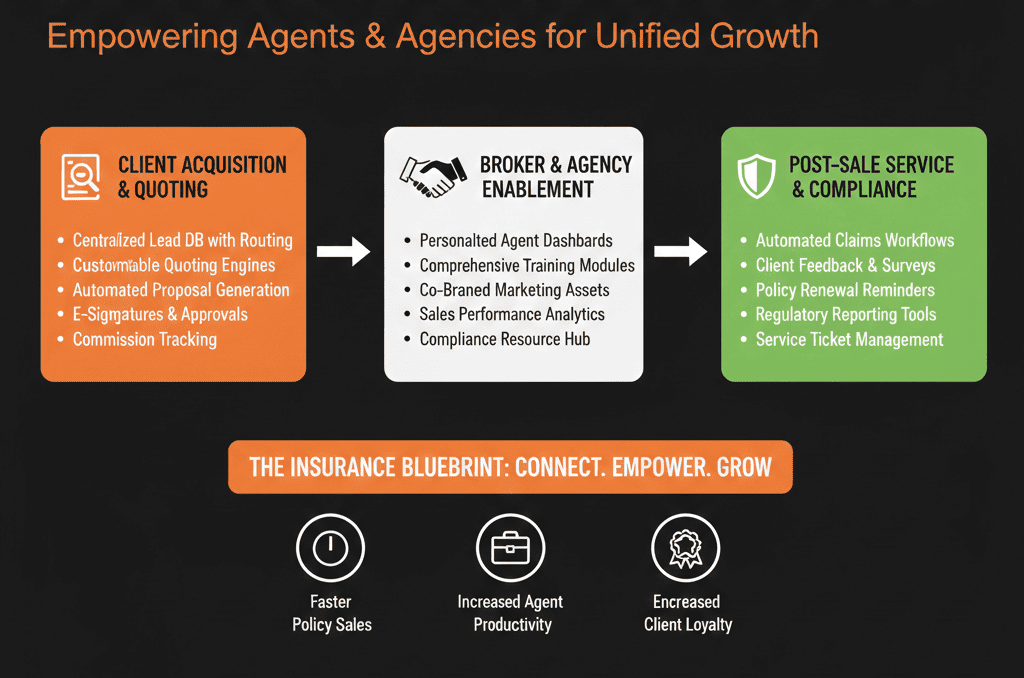
Use Case 1 – Producer and Agency Relationship Management
Problem
You’re not just managing end clients. You’re managing:
- Producers and sub-agents.
- Downline brokers.
- Referral partners and introducers.
Too often:
- Producer data lives in static spreadsheets.
- Communication is fragmented.
- No central view of which producers are active or declining.
How to use HubSpot
Model producers and agencies as Companies and Contacts:
- Companies: producer agencies, independent brokerages, clusters.
- Contacts: individual producers, principals, marketing contacts.
Classify relationships with standardized properties:
- Company type (Producer, Agency, Carrier, End Client).
- Producer status (Active, Inactive, Prospective).
- Tier (Gold/Silver/Bronze, A/B/C).
Use dropdown/select properties so values stay consistent across the network.
Assign owners and territories:
- Producer managers or distribution reps own Companies.
- Fields: region, line of business focus, carriers they place with.
Track all key interactions:
- Emails, meetings, events, and notes captured on the timeline.
- Tasks for follow-ups and producer development conversations.
Outcome:
- One view of your producer network health.
- Clear accountability for who owns which relationships.
Use Case 2 – Opportunity and Policy Pipelines for Distribution
Problem
Policies often go through:
- Quoting across multiple carriers.
- Negotiation on terms.
- Binding and issuance.
- Renewals and mid-term changes.
Without a clear CRM pipeline:
- It’s hard to see what’s in-flight.
- Management can’t forecast commissions.
- Producer performance is opaque.
How to use HubSpot
Create a New Business pipeline that matches your submission → bind flow.
Example stages:
- Submission Received
- Quoting / Marketing to Carriers
- Proposal Created
- Proposal to Producer/Client
- Negotiation / Revisions
- Bound / Policy Issued
- Closed Lost
Track core deal/policy info in HubSpot (on Deals representing opportunities/policies in placement):
- Producer/Agent (associated Contact/Company).
- End client (Company).
- Line of business (Commercial Property, Liability, Life, Health, etc.).
- Estimated premium and estimated commission.
- Target effective date.
- Carrier(s) being approached (multi-select or a “marketed carriers” field).
Connect to your policy/AMS system:
- HubSpot holds the commercial opportunity.
- The policy system holds detailed policy data.
- Sync/import summary fields into HubSpot (policy number, status, effective/expiry) for visibility.
Outcome:
- Real-time view of distribution pipeline.
- Ability to forecast commissions and capacity by line and producer.
Use Case 3 – Renewal and Retention Workflows
Problem
Renewals are the lifeblood of insurance, but:
- Reminders and tracking are scattered.
- Some renewals are missed or rushed.
- Upsell or cross-sell at renewal is hit-or-miss.
How to use HubSpot
Model renewal opportunities:
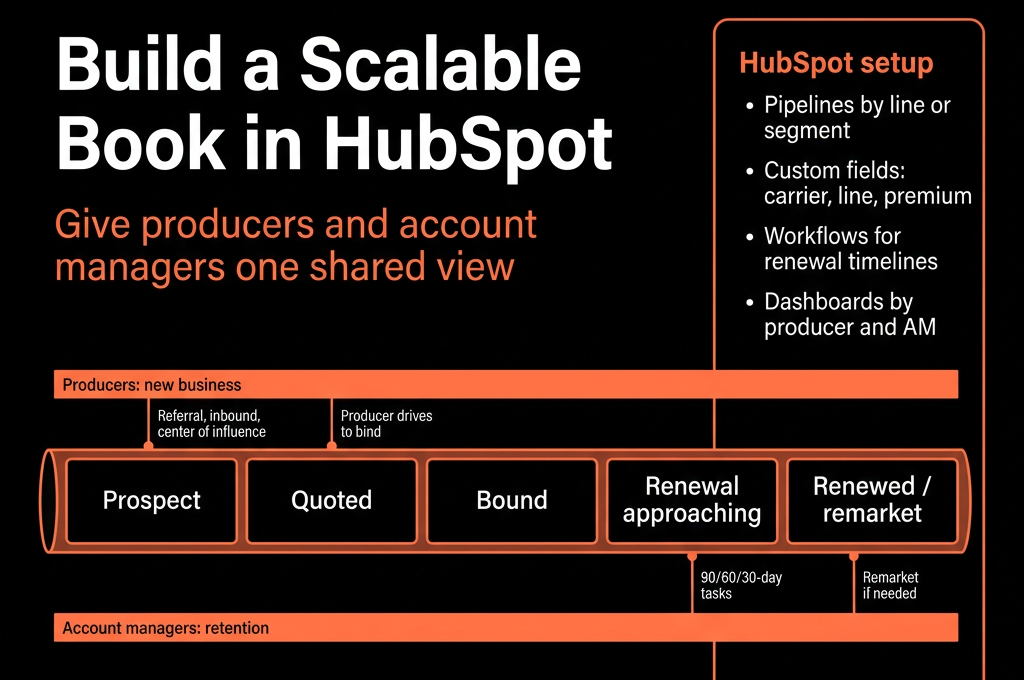
- Use a separate Renewals pipeline, or tag deals with Deal type (New / Renewal / Remarketing).
Sync or import key policy dates:
- Policy effective and expiry dates.
- Renewal options (auto-renew, remarket, etc.).
Use workflows/pipeline automations to create renewal deals and tasks:
- X days before expiry (e.g., 90/120 for commercial lines, 30/60 for personal lines), create a Renewal deal or ticket and assign it.
- Set tasks for reviewing claims/history, contacting producer/client, and quoting alternatives if needed.
Build retention dashboards:
- Policies/Deals up for renewal by month/quarter.
- Retained vs lost premiums by line and producer.
- Reasons for non-renewal (where tracked).
Outcome:
- Fewer renewal surprises.
- Structured renewal and cross-sell motion.
- Clearer view of retention and churn drivers.
Use Case 4 – Cross-Sell and Upsell Across Lines of Business
Problem
Producers and networks leave money on the table when:
- Clients buy one line (e.g., liability) but not others (e.g., property, benefits, specialty).
- No central view of what each client or producer’s book includes.
How to use HubSpot
Track existing lines per client:
- On the Company (end client), use booleans or multi-select for lines in force (Property, Liability, Auto, Workers’ Comp, Benefits, Life, etc.).
- Track total premium/commission at a summary level per line where feasible.
Identify cross-sell gaps:
- Views/lists: Clients with Liability but no Property; Benefits clients with no P&C; high premium in one line with zero in others.
Trigger cross-sell workflows:
- Create tasks for producer managers to reach out with targeted cross-sell opportunities.
- Send campaigns promoting coverage bundles or new lines.
Measure cross-sell success:
- Cross-sell pipeline and conversion by line and producer.
Outcome:
- Systematic cross-sell instead of ad hoc attempts.
- Increased revenue per client without extra lead acquisition.
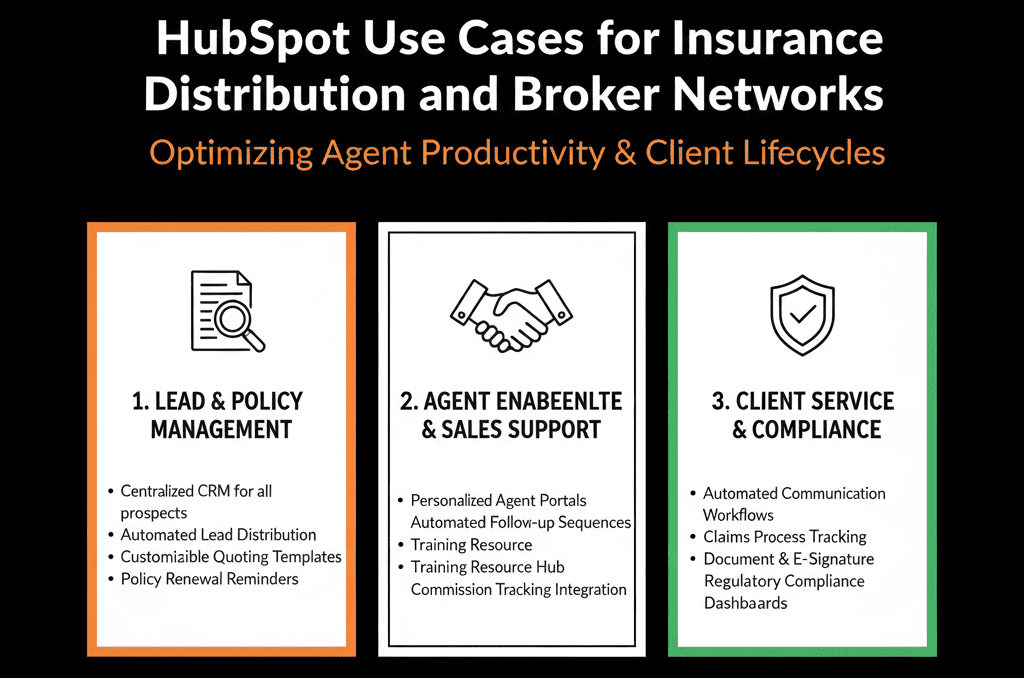
Use Case 5 – Producer Performance and Compensation Visibility
Problem
Networks and MGAs need to:
- Reward high-performing producers.
- Identify those who need support or aren’t a fit.
- Align incentives with profitable business.
But:
- Performance data lives in policy/AMS systems and spreadsheets.
- It’s difficult to slice by line, region, or producer without manual work.
How to use HubSpot
Associate producers with deals:
- Use a Producer field and Company/Contact associations.
Track commissionable premium in HubSpot (summary level):
- Written premium.
- Estimated commission.
- Line of business.
Build dashboards by producer:
- Pipeline and premium by producer.
- Closed-won premium by period.
- Win rate and average deal size.
- Retention rates (for producers with existing books).
Filter by profitability segments:
- If you pull basic loss ratio/profitability indicators from core systems, show “premium from profitable segments” vs total.
Outcome:
- Fact-based producer conversations.
- Better decisions about recruiting, training, and compensation programs.
Use Case 6 – Carrier and Product Performance Visibility
Problem
As a distributor, you need to:
- See which carriers/products are winning or losing.
- Understand hit ratios by carrier and line.
- Optimize market placement strategies.
How to use HubSpot
Track carrier relationships on deals:
- Carrier field (single or multi-select) on Deals.
- Marketed carriers (who quotes vs who wins).
Capture simple performance indicators:
- Which carrier was bound.
- Which ones declined or lost.
- Reason codes where available.
Build carrier performance dashboards:
- Win rates and bound premium by carrier & line.
- Hit ratios: Submissions → Quotes → Binds.
Share insights with carriers (where appropriate):
- Where they’re competitive.
- Where they’re losing.
- Where new products might be needed.
Outcome:
- Stronger carrier relationships.
- Data-backed conversations about appetite and pricing.
- Better placement strategies.
What You Can Do in the Next 30–60 Days
If you run or support an insurance distribution or broker network:
- Start with producer and pipeline clarity: get producers and agencies into HubSpot as Companies & Contacts, and build a basic New Business pipeline that matches submission → bind flow.
- Add a few key Deal fields: line of business, producer, end client, carrier(s), written premium / estimated commission.
- Implement one use case first: renewal workflow for a specific line, referral/producer performance tracking, or cross-sell gap identification.
- Use early results to show producers and leadership how HubSpot helps them see and grow their books, then justify deeper AMS/policy integration.
Want an Insurance-Specific HubSpot Audit?
Insurance distribution and broker networks have complexities many generic CRM implementations ignore:
- Producers and sub-agents.
- Carriers and markets.
- Policies, renewals, and cross-sell.
- AMS/policy system integration.
Our HubSpot Portal Health Check / HubSpot Audit can be tailored to:
- Map your current producer, policy, and renewal flows.
- Identify the best HubSpot use cases to implement first.
- Design a lean, practical architecture around your AMS and policy systems.