
“How Broken Is Too Broken?”
Many teams reach the same point with HubSpot:
- Data is messy.
- Workflows are fragile.
- Properties are out of control.
- Reports are hard to trust.
The question becomes:
“Do we fix what we have?”
“Or do we scrap it and re‑implement properly?”
Both options have costs and risks:
- Full re‑implementation sounds clean but disruptive.
- Incremental fixes feel safer but might never escape legacy design.
In this article, we’ll walk through how to decide between re‑implementing HubSpot vs incrementally fixing it—and when a hybrid approach makes sense.
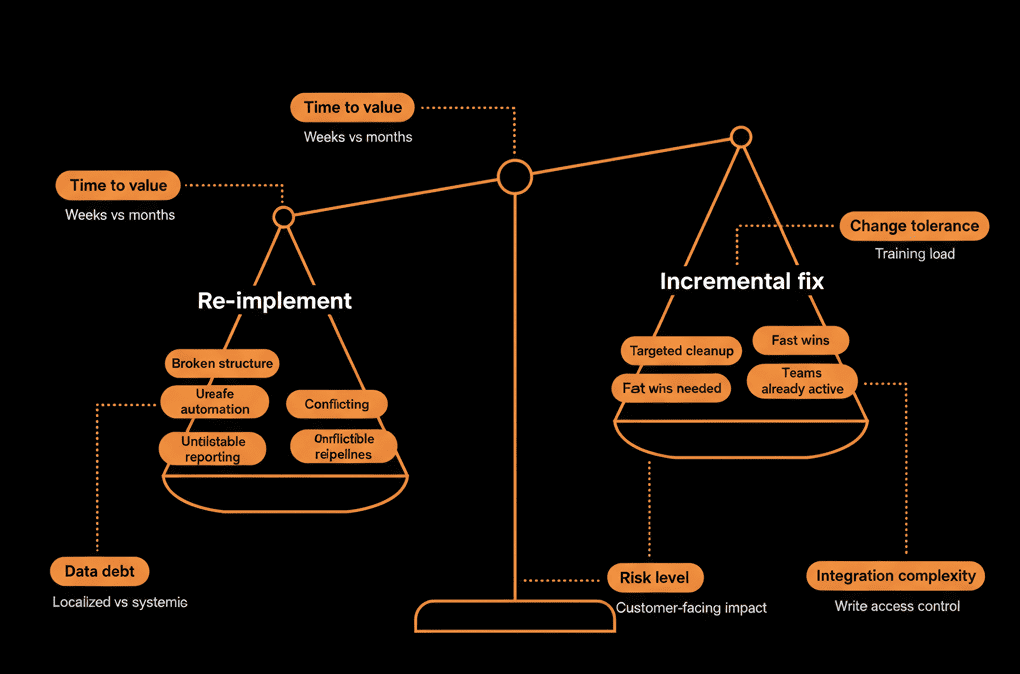
Step 1 – Define What We Mean by “Re‑Implementation” vs “Fixing”
First, clarify the options:
Re‑implementation (a “reset”):
- Design a new HubSpot data model and configuration from scratch (or close).
- Potentially use a new portal (or heavily refactor the existing one).
- Migrate only the data and processes that fit the new design.
- Sunset old objects, fields, and workflows in a structured way.
Incremental fixing (an “evolution”):
- Keep the current portal.
- Gradually clean data, rework workflows, and retire unused properties.
- Adjust processes and reporting over time.
The right choice depends on how deep the problems go.
Step 2 – Diagnose Your Portal Across Five Dimensions
Use these dimensions to assess your current state:
Data model health
- Are objects used correctly (Contacts, Companies, Deals, Tickets, custom objects)?
- Is there massive property bloat and duplication?
- Are key fields (owners, lifecycles, stages) used consistently?
Process & automation
- Are workflows understandable and documented?
- Do stage and lifecycle changes reflect real business processes?
- Or are there many conflicting, legacy automations no one wants to touch?
Integrations
- Are core integrations (billing, product, support) well‑designed?
- Or do they routinely pollute or overwrite key data?
Reporting & trust
- Do leaders trust HubSpot reports for pipeline, funnel, and customer metrics?
- Or does every board/executive deck rely on exports and manual adjustments?
Adoption & behavior
- Are teams using HubSpot as the primary system of record?
- Or do they rely on side systems and spreadsheets?
Score each:
- Green (healthy).
- Yellow (mixed).
- Red (broken).
Step 3 – When Incremental Fixing Makes Sense
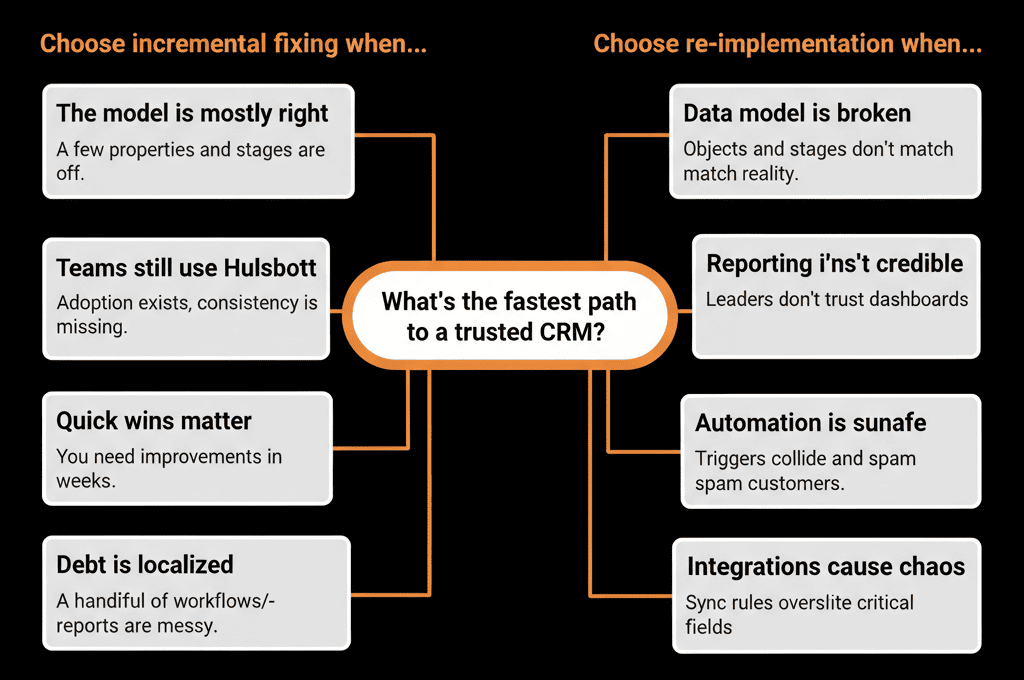
Incremental fixing is viable when:
Data model issues are localized
Some messy properties and inconsistent lifecycles—but core object usage is sound.
Processes roughly match reality
Pipelines and stages mostly reflect how you sell, with some cleanup needed.
Integrations are not fundamentally flawed
A few mis‑mapped fields or minor pollution issues, but fixable.
Reports are “mostly right”
Leaders may quibble over definitions, but they recognize the numbers.
Adoption is decent
Teams are in HubSpot daily; they just find parts of it clunky.
In this scenario, you can:
- Run a Health Check.
- Prioritize fixes:
- High‑impact data clean‑up.
- Workflow simplification.
- Validation and guardrails.
- Improve progressively without a major reset.
Pros:
- Less disruptive.
- Faster wins.
- Uses existing portal history.
Cons:
- Limited by legacy design decisions.
- Harder to make deep structural changes.
Step 4 – When a Re‑Implementation (or Near Reset) Is the Better Option
Re‑implementation is worth considering when multiple dimensions are red:
Data model is fundamentally misaligned
- Wrong objects used for things (e.g., Deals as “accounts,” Contacts for everything).
- Property bloat is so severe that cleaning it would be as much work as starting fresh.
Automation is a black box
- Dozens/hundreds of workflows with unclear ownership and side effects.
- Changes in one area often “break” unrelated processes.
Integrations are deeply entangled
- Legacy connections (e.g., to old CRMs) still live.
- External tools overwrite owner, lifecycle, segmentation frequently.
Reporting is unreliable
- Different teams pull conflicting numbers from HubSpot.
- Finance and leadership don’t trust CRM data.
Adoption is weak or fragmented
- Sales/CS work in other tools or spreadsheets.
- HubSpot is seen as “just a marketing platform” or a backup.
In these cases, trying to fix incrementally can:
- Take longer.
- Cost more.
- Still leave you with a compromised design.
Re‑implementation can mean:
- New portal (cleanest, but more drastic).
- Or deep structural overhaul in the same portal with clear deprecation and cutover.
Pros:
- Clean design aligned with today’s business.
- Opportunity to reset processes and behaviors.
- Easier to implement robust governance.
Cons:
- More disruptive.
- Requires careful change management and migration planning.
Step 5 – A Simple Decision Matrix
You can use this high‑level guide:
If:
3–5 of the five dimensions are Green/Yellow → Incremental Fix is usually best.
3+ dimensions are Red, especially data model + automation + reporting → Re‑implementation is often more efficient long‑term.
Also consider:
Time horizon
Do you need major improvements in 3–6 months?
Or are you planning for a 1–3 year system of record strategy?
Org change appetite
Are teams open to bigger shifts and training?
Or is there low tolerance for disruption right now?
Sometimes the answer is a hybrid:
- Immediate incremental fixes to stop the bleeding.
- A planned re‑implementation in the medium term.
Step 6 – How a Hybrid “Fix + Re‑Implement” Approach Works
A hybrid strategy recognizes you may need both, in sequence.
Phase 1 – Stabilize and Fix Critical Issues
Run a Health Check to:
- Fix the most painful data and automation issues.
- Protect lead flow, pipeline, and reporting.
Short‑term targets (30–90 days):
- Routing works.
- Forecast is usable.
- Key reports are aligned on definitions.
Phase 2 – Blueprint a Clean Future State
In parallel, design a new HubSpot architecture:
- Objects, properties, pipelines, and lifecycles.
- Integration strategy and governance.
Decide whether this future state lives in:
- The existing portal (with structured refactoring).
- Or a new portal with a planned migration.
Phase 3 – Execute Re‑Implementation or Deep Refactor
- Migrate only necessary data into the new design.
- Rebuild essential workflows and integrations.
- Decommission legacy structures and unused fields systematically.
This way, the business gets stability now and a clean system later.
Step 7 – Consider Costs, Risks, and Payback for Each Path
When presenting options internally, compare:
Incremental Fixing
Costs:
- Primarily RevOps/consulting time.
- Ongoing clean‑up and optimization.
Risks:
- May never fully escape legacy compromises.
- Slower path to a truly “clean” system.
Payback:
- Faster small wins.
- Lower short‑term disruption.
Re‑Implementation
Costs:
- Higher up‑front architecture and migration effort.
- Training and change management.
Risks:
- If poorly managed, can disrupt operations.
- Requires strong planning and buy‑in.
Payback:
- Cleaner, scalable system.
- Easier to govern and extend.
- Better long‑term ROI if current setup is deeply flawed.
Leaders will usually back the option where:
- Risk is clearly mitigated.
- Payback is quantified and realistic.
- The path is staged, not all‑or‑nothing.
Step 8 – Use a Health Check to Make the Decision with Evidence, Not Guesswork
If you’re not sure which path you’re on, start with a structured HubSpot Health Check:
It should cover:
- Data quality and model analysis.
- Workflow and automation review.
- Integration mapping and behavior.
- Reporting vs business questions.
- Adoption and usage patterns.
Output:
- A clear assessment per dimension (Green/Yellow/Red).
- Specific recommendations:
- “These 10 things we can fix in‑place.”
- “These 5 structural issues argue for a re‑implementation.”
This turns the question from “What do we feel like doing?” into:
“Given this evidence, which option gives us the best long‑term outcome?”
Pulling It Together: Pick the Path That Solves the Right Problem
Re‑implementing vs incrementally fixing HubSpot is not a philosophical choice.
It’s a decision about:
- The depth of your current issues.
- Your tolerance for disruption.
- Your timeline and growth plans.
In summary:
- If your portal’s issues are localized and teams are already using it → Incremental Fix.
- If core design, automation, integrations, and reporting are fundamentally broken → Re‑Implementation (possibly after short‑term stabilization).
- If you’re in the messy middle → Hybrid: stabilize now, rebuild with a blueprint later.
Either way, the right first move is a clear, honest diagnosis.
Want Help Choosing—and Executing—the Right HubSpot Fix?
If you’re stuck between “we can probably fix this” and “we should start over,” this is exactly where we can help.
Our HubSpot Portal Health Check and Migration & ROI Plan are designed to:
- Assess your current HubSpot across data, process, integrations, reporting, and adoption.
- Recommend a clear path: incremental fix, re‑implementation, or hybrid.
- Provide a phased roadmap to get from today’s state to a clean, scalable HubSpot system.