

Leadership Doesn’t Buy “Better CRM.” They Buy ROI.
Inside the GTM team, the case for HubSpot feels obvious:
- “Our current CRM is a mess.”
- “Nobody trusts the data.”
- “We’re duct‑taping tools together.”
But when you take this to the leadership team or board, you hear:
- “What’s the payback period?”
- “Can’t we just fix what we have?”
- “How much will this really move the needle?”
Emotionally, everyone is tired of the current setup.
Financially, they need an ROI story.
In this article, we’ll walk through a practical ROI model you can use to justify a HubSpot migration—using your numbers, not vague promises—so leadership can make a clear, confident decision.
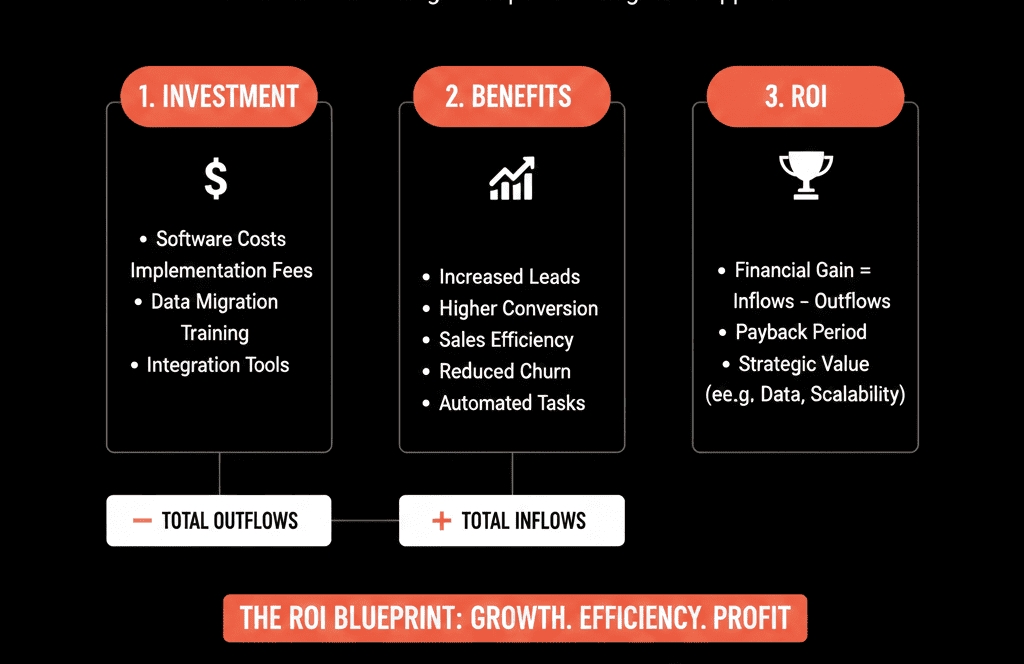
Step 1 – Define the “As‑Is” Pain in Concrete, Measurable Terms
Start by quantifying life before HubSpot in a few key areas. You can keep estimates conservative; you just need directional truth.
Time waste in GTM execution
- Reps hunting for data, fixing duplicates, working from spreadsheets.
- Marketing manually building lists and reports across tools.
- Ops firefighting integrations and data issues.
Conversion and speed‑to‑lead problems
- High‑intent leads not followed up quickly or consistently.
- Deals stalling due to lack of process and visibility.
Reporting and decision‑making gaps
- Leadership operating on outdated or conflicting numbers.
- Forecasts consistently off.
Tool sprawl and overlapping spend
- Multiple tools doing what HubSpot could do natively.
- Extra integration costs.
Risk and compliance exposure
- Inconsistent consents.
- Access controls and data handling scattered across systems.
Your baseline ROI story starts here.
Step 2 – Estimate Time Savings with Conservative Assumptions
Time savings are often the easiest and safest part of the ROI model.
Example structure:
Sales
Assume:
- 10 reps.
- Each wastes 20 minutes/day on:
- Finding/contacting the right leads.
- Updating multiple systems.
- Rebuilding their own views and reports.
That’s:
20 min × 10 reps × 5 days = 1,000 minutes/week.
1,000 / 60 ≈ 16.7 hours/week.
~67 hours/month.
At a blended cost of, say, $60/hour:
67 × $60 ≈ $4,020/month.
≈ $48,000/year.
Marketing/Ops
Assume:
- Marketing+Ops spend an extra 20 hours/month on manual list building, reporting, and data cleanup due to the current stack.
At $60/hour blended:
20 × $60 = $1,200/month.
≈ $14,400/year.
Even before counting productivity gains (more calls, more campaigns), you’re looking at ~$60k+/year in reclaimable time with modest assumptions.
Step 3 – Estimate Revenue Uplift from Better Lead Handling and Pipeline
Next, estimate the top‑line impact from improvements HubSpot can realistically deliver.
Speed‑to‑lead improvements
Example:
You receive 100 high‑intent leads/month (demos, trials, “contact sales”).
Current reality:
Only 50% are contacted within 24 hours.
After HubSpot (with clean routing, tasks, and sequences):
You target 80–90% within SLA.
Assume:
Contacted within 24h → 30% become opportunities.
Contacted slowly/never → 10% become opportunities.
Today (50/50 split):
50 fast → 15 opps.
50 slow/never → 5 opps.
Total: 20 opps/month.
After HubSpot (80 fast, 20 slow):
80 fast → 24 opps.
20 slow → 2 opps.
Total: 26 opps/month.
Gain:
+6 opps/month.
If avg opp size is $10,000:
6 × $10,000 = $60,000 in additional pipeline/month.
At 25% win rate:
$15,000 in extra revenue/month.
≈ $180,000/year.
Better pipeline management and stage discipline
Conservatively, assume HubSpot + better process:
- Improves win rate by 2–3 percentage points.
- Or shortens sales cycles slightly, freeing capacity.
If your annual closed‑won is $2M, a 2.5‑point win rate improvement might add:
Roughly $50,000–$100,000/year with modest assumptions.
Use round, believable numbers and label them clearly as estimates.
Step 4 – Estimate Savings from Tool Consolidation and Integration Simplification
List tools HubSpot can realistically replace or downsize, such as:
- Email marketing platform.
- Basic marketing automation tools.
- Simple ticketing or survey tools.
- Outbound sequencing tools.
- Bits of Zapier/Make automation used just to connect GTM tools.
Example:
- Email/automation tool: $800/month.
- Sales engagement tool: $600/month.
- Basic ticketing tool: $400/month.
- Assorted small tools and integrations: $200/month.
Total potential consolidation:
≈ $2,000/month.
≈ $24,000/year.
You may not cut everything immediately, so model:
- 50% consolidation in Year 1: ~$12,000.
- 75–100% in Year 2, depending on adoption and rollout.
Add in:
Reduced integration maintenance (fewer brittle Zaps, custom scripts, or admin hours).
Even 5–10 Ops hours/month reallocated is another ~$4,000–$7,000/year.
Step 5 – Factor in Risk Reduction (Even Qualitatively)
Risk is harder to quantify but leadership cares a lot.
HubSpot, properly implemented, can reduce risk in:
Compliance and consent
- Clear subscription types and consent tracking.
Security and access
- Centralized permissions and audit logs.
Data integrity
- Fewer copies of personal data spread across unknown tools.
You can express this as:
- Avoided cost of potential issues (e.g., non‑compliant send, data breach in an abandoned tool).
- Greater confidence in board reporting (forecast and pipeline data from a single system).
You don’t have to put a big dollar sign here, but do call it out as part of the ROI story.
Step 6 – Build a Simple, Credible ROI Model
Now pull it together into a simple annual view.
Using conservative numbers from above:
Time savings (Sales + Marketing/Ops)
≈ $60,000/year.
Revenue uplift from improved lead handling and win rates
Extra won revenue: ≈ $180,000 + $50,000 (from small win rate lift) ≈ $230,000/year.
Tool consolidation and integration savings
Year 1: ≈ $12,000–$20,000/year (partial consolidation).
Total annual upside (conservative)
$60,000 + $230,000 +, say, $15,000 = $305,000/year.
Subtract migration + HubSpot costs
Example:
- HubSpot licenses incremental vs current: $40,000/year.
- One‑time migration + implementation: $50,000.
Year 1 cost: $90,000.
Year 1 net ROI estimate:
$305,000 upside – $90,000 cost = $215,000 net benefit.
Year 2 and beyond (implementation cost gone):
Upside: $305,000.
Ongoing HubSpot cost: $40,000.
Net: $265,000/year.
You can simplify further:
- Payback period: < 6 months.
- 3–5x ROI over 24 months even on conservative assumptions.
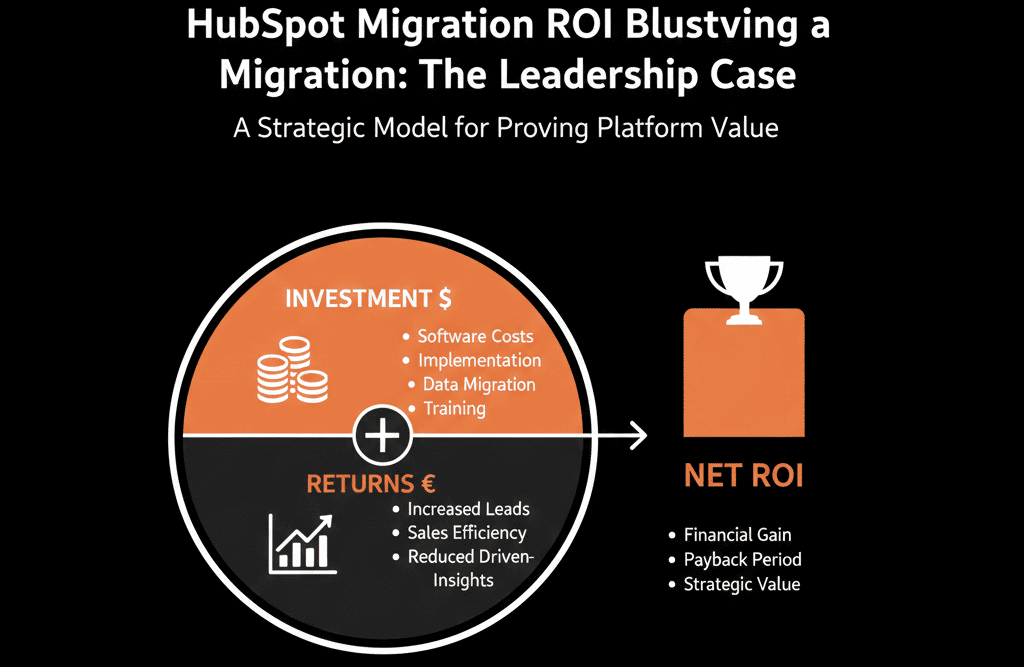
Step 7 – Package the ROI Story for Leadership
When presenting to leadership, keep it clear and business‑focused:
Problem framing
“Here’s how our current stack is blocking us: time waste, lost leads, bad forecasts, tool sprawl.”
Proposed solution
“Consolidate GTM into HubSpot as our single system of record, with a planned migration.”
ROI summary
Show the annual upside and costs in a simple table.
Assumptions
Highlight that you used conservative estimates. Invite feedback to adjust numbers with Finance.
Risk and mitigation
“Here’s how we’ll migrate without disrupting sales.”
“Here’s how we’ll handle compliance and data quality.”
Clear ask
- Budget approval (licenses + implementation).
- Internal resources (time from Sales, Marketing, Ops).
- A timeline tied to milestones and expected impact.
The goal is not a perfectly precise model.
It’s a credible, grounded case that the upside is large and the payback is short.
Step 8 – Back the ROI Model with a Realistic Migration Plan
Leaders will also ask: “Can we actually execute this?”
Be ready with:
- A 60–90 day migration and rollout plan.
- Milestones tied to outcomes, not just tasks:
- “Day 30: clean data model and test imports.”
- “Day 60: sales live in HubSpot with lead routing and pipeline.”
- “Day 90: core dashboards and decommissioned legacy tools.”
Link milestones back to your ROI drivers:
- “We start seeing time savings once X is live.”
- “We unlock revenue uplift once lead routing, SLAs, and sequences are live.”
- “We reduce tool spend after decommissioning tools A, B, C.”
This shows leadership that the ROI is not theoretical; it’s mapped to concrete work.
Pulling It Together: Turn “We Need HubSpot” into “We Can’t Afford Not To”
To justify a HubSpot migration to leadership, you don’t need:
- A 100‑page business case.
- Perfectly precise numbers.
You do need:
- A clear view of current pain—time, revenue, tools, and risk.
- Conservative, believable estimates of upside.
- A simple financial model showing payback and net benefit.
- A realistic migration plan that doesn’t tank a quarter.
When you can say:
“We’re likely leaving at least $X on the table every year due to our current setup. This HubSpot migration will cost ~Y and conservatively return 3–5x that within 24 months.”
You move the conversation from “nice to have” to “strategic investment we’re already overdue on.”
Want Help Building a HubSpot Migration ROI Model for Your Leadership Team?
If you know your current CRM and GTM stack is holding you back—but you need a clear ROI story to get HubSpot funded—this is exactly where we can help.
Our HubSpot Portal Health Check and Migration & ROI Plan are designed to:
- Quantify your current time waste, revenue leakage, and tool sprawl.
- Model the impact of moving to a well‑architected HubSpot portal.
- Package the findings into a board‑ready ROI and migration plan.